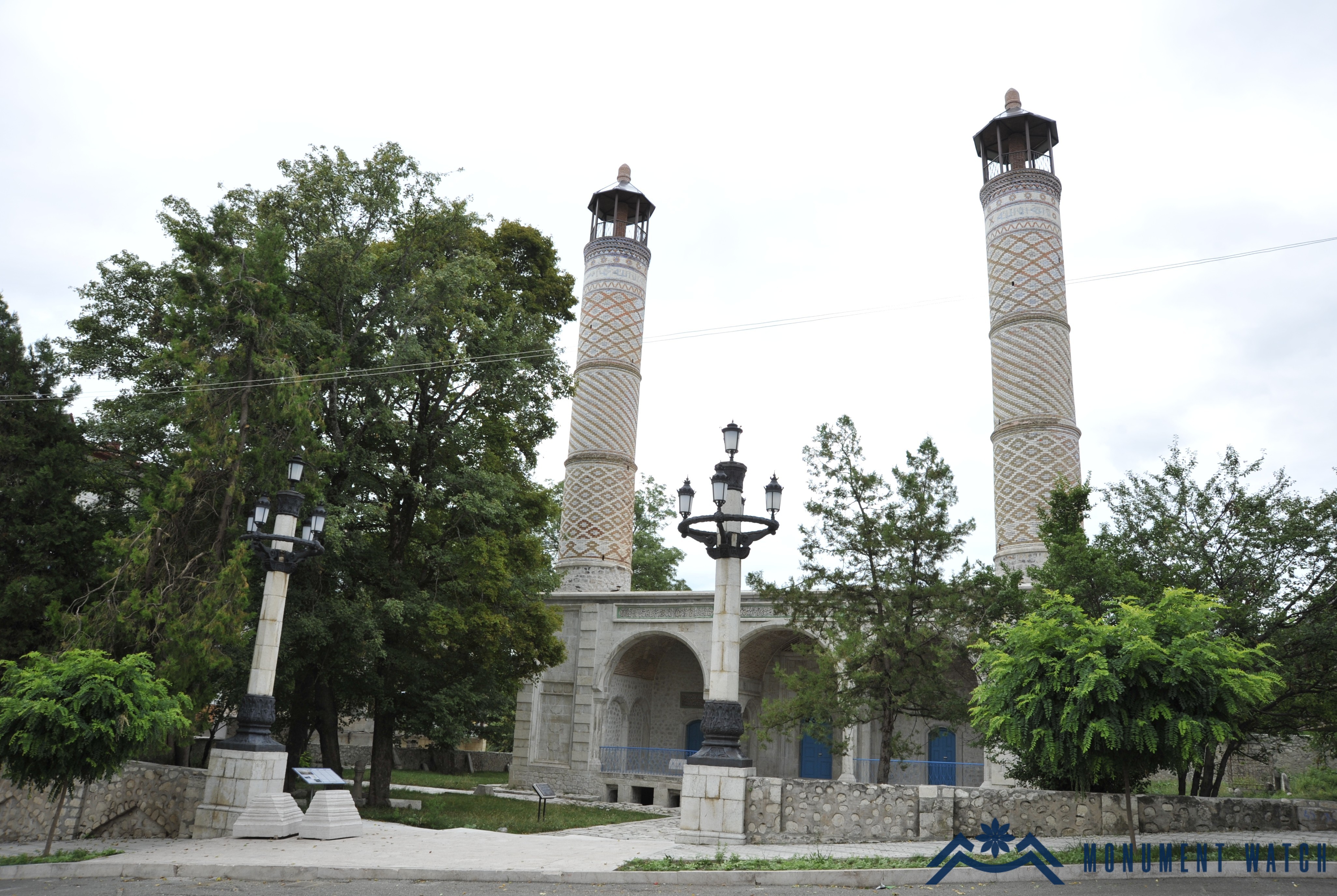
On Aliyev’s Latest Statements Regarding the Mosques of Shushi
On July 4, 2025, in the occupied city of Shushi in Artsakh, Azerbaijan's President Ilham Aliyev, during a meeting with the President of Iran, addressed the Islamic cultural heritage of Shushi. In video footage broadcast by various outlets, Aliyev presented the Upper (Verin) Mosque of Shushi to his guest and asserted that Armenians had deliberately demolished 16 of the city's 17 mosques, leaving only one half-ruined (https://t.me/Caucasian_bureau/101937?fbclid=IwY2xjawLWDThleHRuA2FlbQIxMABicmlkETAyQkRlc3BZWUFhcWVnTk1JAR4bYjcS_6Pxr56nlKRJYiFO7L0jkjWkGmlSRJvFw_ruT7ZLuwOBCBNf68Tvxw_aem_kvU5IMaITRP4ICoOezhxsQ).
Since the end of the 44-day war in 2020, President Aliyev has repeatedly claimed that Armenian forces destroyed Karabakh's mosques, offering contradictory figures for how many there once were and how many survive. In some speeches he described them as "entirely ruined," in others merely "damaged," yet more recent rhetoric emphasizes destruction—despite publicly posted photographs from 2021–2022, issued by official Azerbaijani "documentaries" of alleged Armenian "atrocities," showing many mosques still standing, and some only in need of repair (https://islamnews.ru/vse-razrushennye-v-karabakhe-mecheti-budut-vosstanovleny; https://cbctv.az/news/122022/prezident-ilxam-aliev-vo-vremya-okkupacii-iz-67-mecetei-armeniei-byli-polnostyu-razruseny-65). Most of the mosques documented in Artsakh are rural structures—rectangular‐plan prayer halls with unadorned exteriors—which Soviet‐era scholarship seldom investigated. Few photographs, drawings, or inventories exist from that period, and many were never officially recorded. Consequently, official counts of "mosques destroyed" diverge sharply from any contemporaneous on-site surveys—and the overall Soviet-era registry of monuments outside the former NKAO was notoriously incomplete or even exaggerated (Hovsepyan 2024:103; Garabaghli 2019:69 71).
In fact, following the establishment of the Republic of Artsakh, its authorities assumed responsibility for preserving Islamic monuments. Many of these sites received their first scientific study by Armenian researchers, and the Artsakh Ministry of Culture drew up detailed documentation and protection zones for numerous cemeteries and mosques—including rural prayer houses. Scholarly publications on Artsakh's cultural heritage have routinely addressed these monuments, and conservation efforts were undertaken: in 2010, the Aghdam Mosque received routine repairs; the Shahbulagh fortress and its adjacent mosque were restored; Shushi's Seyidli Mosque was refurbished; and in 2019, the Upper Mosque of Shushi underwent a significant structural restoration. Archaeological excavations preceded the restoration of the Shahbulagh and Upper Mosque, and although the scope was limited by funding and other challenges, these constraints were openly acknowledged (Hovsepyan 2024:103-104).
According to Decision No. 145 of April 27, 1988, which listed Shushi's state-protected cultural monuments, the city contained 14 Islamic religious structures: the two principal urban mosques (Upper and Lower) and several neighborhood prayer houses. Azerbaijani scholar E. Avalov, writing in the 1970s, noted that some of these prayer houses were already in poor condition, with visible cracks and partial collapses (Avalov 1977: 80–106; Hovsepyan 2024: 101–104).
Photographs of Shushi's mosques taken before the 2020 occupation clearly show many buildings still standing—some in good repair, others bearing damage consistent with Avalov's earlier observations and with the effects of 1992 hostilities—but by no means universally "destroyed." During the Republic of Artsakh period, several mosques were actively renovated: the central Upper Mosque, the Saatli Mosque, the Mama Mosque, the Haji Yusifli Mosque, and the Taza Mosque (which later housed a geology museum). Saatli, Haji Yusifli, and Mama mosques were refurbished with private funding. Importantly, not only the buildings themselves but also their Arabic epigraphs and the cemetery adjacent to the Upper Mosque remained intact.
In light of this evidence, President Aliyev's claims about the wholesale destruction of Shushi's mosques are demonstrably false.
Bibliography
- Hovsepyan, R. 2024. "Problems of Research and Preservation of Islamic Monuments in Artsakh," in Armenia as a Civilizational Crossroads: Historical and Cultural Interactions, International Conference Proceedings, Yerevan, 99–107.
- Avalov, E. 1977. The Architecture of Shushi and the Problems of Preserving Its Historic Character, Baku, 80–106.
- Garabaghli, R. 2019. "Monuments of Architecture in Fizuli (Mosques)," Problems of Arts and Culture: International Scientific Journal 1(67), 62–71.