The Ded (Natarin) Fortress
Location
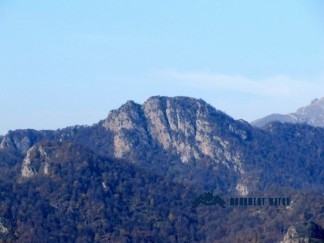
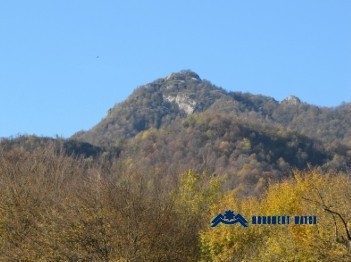
The fortress is located near the village of Garnakar in the Martakert Region of the occupied Republic of Artsakh, on the highest mountain of the upper valley of the Khachenaget River, which the locals call "Panjak Kar" (Sargsyan 2002, 68). The fortress stands at an elevation of 1,933 meters, on the very summit of the mountain (Fig. 1, 2). From the fortress, an expansive view opens toward the Khachen Valley and the surrounding areas (Sargsyan 2002, 68–69). Makar Barkhudaryants gives the following brief description of the fortress: "This fortress is almost the equal and counterpart of Khohanaberd. The former is located to the south of the latter at a distance of a quarter mile; only the path up to Natar is not so dangerous" (Barkhudaryants 1895, 199). Let us note that Khohanaberd was among the most inaccessible strongholds of Inner Khachen; not far from it stood the princely residence of Hasan-Jalal, known as Darpasner ("The Gates") (Ghulyan 1984, 51–53).
Historical overview
After these events, Buqa’s persecutions against Prince Hasan-Jalal intensified further. The lord of Khachen appealed to Batu Khan concerning Buqa’s unlawful actions and recovered a number of his fortresses; Gandzaketsi, however, does not list Ded among those returned (Ulubabyan 1975, 196–203).
According to S. Sargsyan, the Ded fortress cited by Gandzaketsi is identical with Natarin. In his view, the name Ded is connected with the sense of “watch/guard/lookout,” and Natarin is interpreted in the same way (Sargsyan 2002, 70–71).
Architectural–Compositional Description
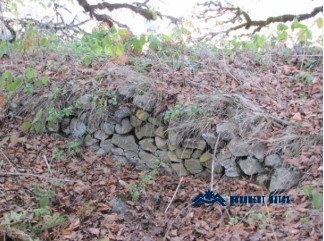
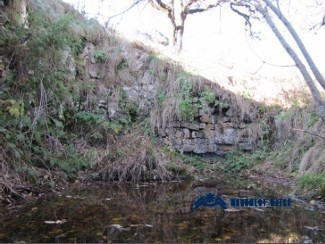
The fortress occupies an area of about 2.5 ha. Its only entrance is on the northern side of the summit, in a sector where the remains of eight small rooms can be traced along roughly 26 m; their floor areas range between 9–15 sq m (Fig. 3). It should be borne in mind that the site has not been subjected to archaeological investigation, and the measurements are approximate, reflecting the current condition. The area is covered with abundant vegetation. At the highest point of the fortress stand a tower (3.1 × 2.6 m) and a water cistern (6.6 × 5 m); other structural remains are also visible on the summit (Fig. 4). The observed constructions are built of local grey-bluish undressed and roughly hewn stones, set in lime mortar. No encircling curtain walls or (flanking) towers are discernible within the precinct—likely owing to the fortress’s placement on a natural mountain peak. At the same time, along rock-bound edges and perimeter zones, the walls of the structures are built of comparatively large stones and are notable for their thickness and solidity (Sargsyan 2002, 69–70).
The Condition Before and After the War
The fortress did not incur damage during the Artsakh wars. It requires a comprehensive archaeological investigation.
Bibliography
1. Barkhutareants 1895 - Barkhutareants M., Artsakh, Baku.
2. Kirakos Gandzaketsi 1961 - Kirakos Gandzaketsi, History of the Armenia, ed. K. A. Melik-Ohanjanyan, Yerevan.
3. Ghulyan 1984 - Ghulyan A., “The Princely Palace of Khachen,” Herald of Social Sciences (Yerevan), no. 3, pp. 51–57.
4. Manandyan 1952 - Manandyan H., A Critical Survey of the History of the Armenian People, vol. III, Yerevan.
5. Sargsyan 2002 - Sargsyan S., The Fortresses of Khachen, Stepanakert.
6. Ulubabyan 1975 - Ulubabyan B., The Principality of Khachen in the 10th–16th Centuries, Yerevan.
The Ded (Natarin) Fortress
Artsakh