
The Surb Amenaprkich (Holy Savior) Church of Krkzhan
Location
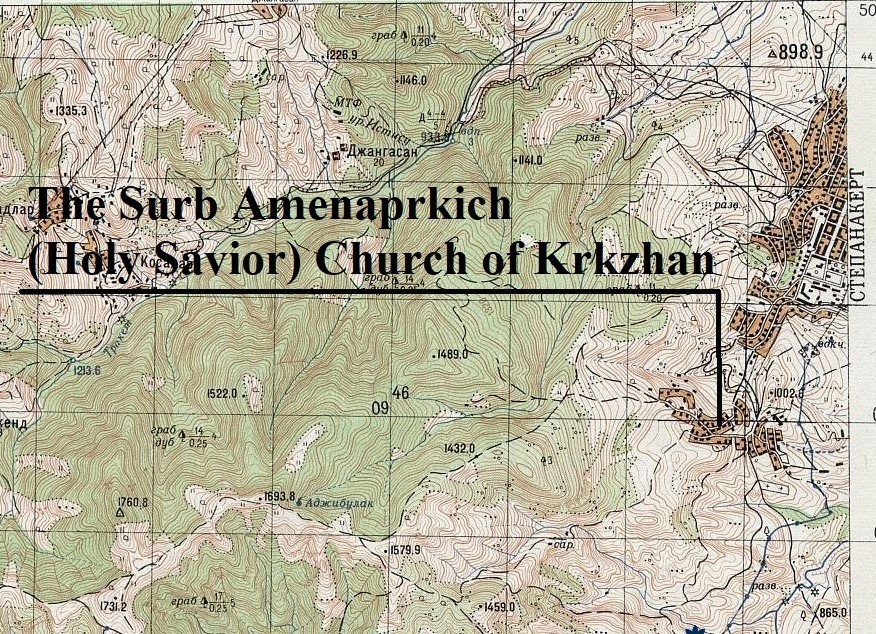
The ruins of Surb Amenaprkich are located in the "Krkzhan" region of Stepanakert, on its elevated section (Fig. 1). In the 19th century, within the administrative boundaries of present-day Stepanakert were the Armenian villages of Vararakn, Krkzhan, Pahlul, Nerkin Shen, Soghomoni Shen, and others, about which a considerable number of attestations have been preserved in 19th-century sources (Balayan 2020, 13–16; Barkhutareants 1895, 152–153).
Historical Overview
According to M. Barkhudaryants, the village of Karkajan was situated “on an eminence between Ghayibalu and Khankeandu; the church—Surb Amenaprkich (Holy Savior)—is built of stone and lime; the priest comes from Ghayibalu.” (Barkhutareants 1895, 152). Accordingly, by the late nineteenth century, the church was still standing, and the village’s inhabitants are attested as indigenous Armenians.
Architectural–Compositional Examination
The church is built of small- and medium-sized semi-dressed and undressed stones set in lime mortar (Fig. 2). Although ruined, it is evident that it was a single-nave, barrel-vaulted hall, like many rural churches of Artsakh in the 19th century. Its dimensions are 11.9 × 4.3 meters. Portions of the west, north, and east walls survive (to a height of 2–2.5 m). The structure abuts rock outcrops on the north, west, and east sides and has vast windows, a characteristic of 19th-century churches. From the ruins, it appears that the (now-lost) entrance, the corners, and the window openings were built of relatively well-dressed large stones.
Inside the church, in the section of the north wall adjacent to the bema, the baptismal font has been preserved (Fig. 3).
Around the monument, there are several fragments of khachkars (cross-stones), indicating that before the present church, there stood another, earlier church or sacred site here, on whose location the current church was likely built in the 19th century. Judging by the khachkar fragments, they date to the 12th–13th centuries (Fig. 4). The area also contains pieces of tombstones and intact tombstones with Armenian inscriptions (Fig. 5).
During the Soviet period, a large number of Azerbaijanis were settled in the village of Krkzhan and around the church. They converted the church into cattle shed, which led to its ruin (The Church of the Savior (Surb Amenaprkich) in Krkzhan: Targeted by Azerbaijani Propaganda, https://monumentwatch.org/en/alerts/the-church-of-the-savior-surb-amenaprkich-in-krkzhan-targeted-by-azerbaijani-propaganda/).
The Condition Before and After the War
On March 8, 2025, Azerbaijan’s Ictimai TV broadcast a video presenting the ruined Surb Amenaprkich Church in Krkzhan as “Albanian heritage,” explicitly claiming that “Armenians have Armenianized the local Albanian churches.” The video is titled “Albanian Monuments Demolished in Khankendi” (https://www.facebook.com/watch/?v=390901870312335). At the time, Monument Watch responded to this video ( The Church of the Savior (Surb Amenaprkich) in Krkzhan: Targeted by Azerbaijani Propaganda, https://monumentwatch.org/en/alerts/the-church-of-the-savior-surb-amenaprkich-in-krkzhan-targeted-by-azerbaijani-propaganda/).
Bibliography
- Barkhutareants M., Artsakh, Baku, 1895:
- Balayan V., Outlines of the History of the Settlements of the Republic of Artsakh, Yerevan, 2020:
The Surb Amenaprkich (Holy Savior) Church of Krkzhan
Artsakh