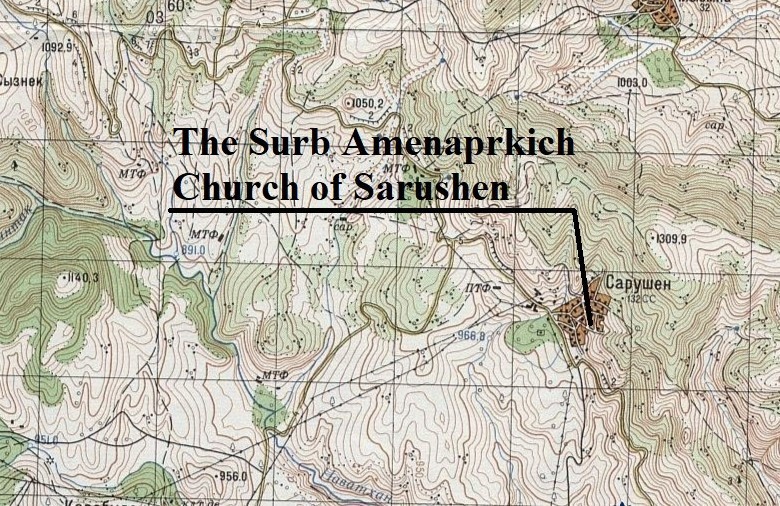
Historical Overview
Makar Barkhudaryants gives the following description of the church:
"…the church is called Amenaprkich, built of stone, constructed on a single vault, old and renovated several times. Its length is 13 meters 50 centimeters, and its width is 8 meters 45 centimeters. In our district, this church holds a foremost place among all the churches in terms of its internal and external brightness, as well as its ornaments and decorations. For this beauty, we are indebted to the caring efforts of the honorable Grigor Agha Ayvazents of Geraznu. …In our church is kept the renowned manuscript Gospel of Sarushen, to which pilgrims come not only from many parts of Artsakh, but also from Baku, Tiflis, and even Muslims." (Barkhudaryants 1895, 102).
According to Makar Barkhudaryants' description, the church is of old construction and has been renovated many times. Its present appearance is the result of a renovation in the second half of the 19th century, attested by an inscription on the lintel, mentioned by Shahen Mkrtchyan, which is no longer preserved. According to that inscription, the church was rebuilt by Grigor Ayvazyants (Mkrtchyan 1985, 147).
Architectural-compositional examination
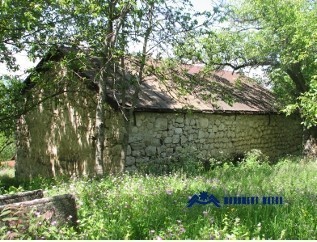
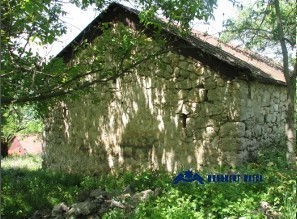
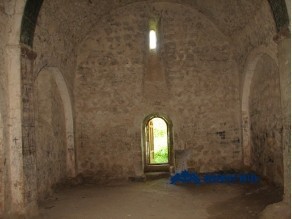
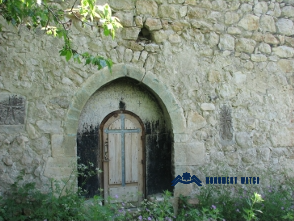
The church is a single-nave hall with a rectangular floor plan. It is built of small and medium-sized, roughly hewn and semi-hewn, whitish limestone with lime mortar. Only the door and window frames are made of dressed stone. The wall corners are laid with large, roughly hewn stones (Fig. 2). The building has a single entrance opening from the west. Inside, the church is covered with a vault; the vault rests on paired wall-arches attached to the northern and southern walls (Fig. 3). It has two sacristies, and lintels of the sacristy doors, reused fragments of tombstones, and khachkars with relief crosses and figurative carvings have been employed.
The single entrance of the church is particularly noteworthy: on one of the stones on the left side of the portal frame, a horse is carved, while on the lower stone, there is a vegetal-geometric ornament. On the main façade, on both sides of the entrance, small khachkars are embedded (Fig. 4).