The Ancient burials of the Uzerlik-tepe settlement
Location
The site is located on a hill at the eastern outskirts of Akna (Aghdam) in the Askeran District of the Republic of Artsakh, at the beginning of the Karabakh plain. Since 2023, the monument has been under occupation by Azerbaijan.
Historical overview
Detailed information on the monument has been preserved in the publications of the archaeologist K. Kushnaryova, who excavated the settlement (Kushnaryova 1959, 388–430; Kushnaryova 1965, 74–102).
Archaeological investigation
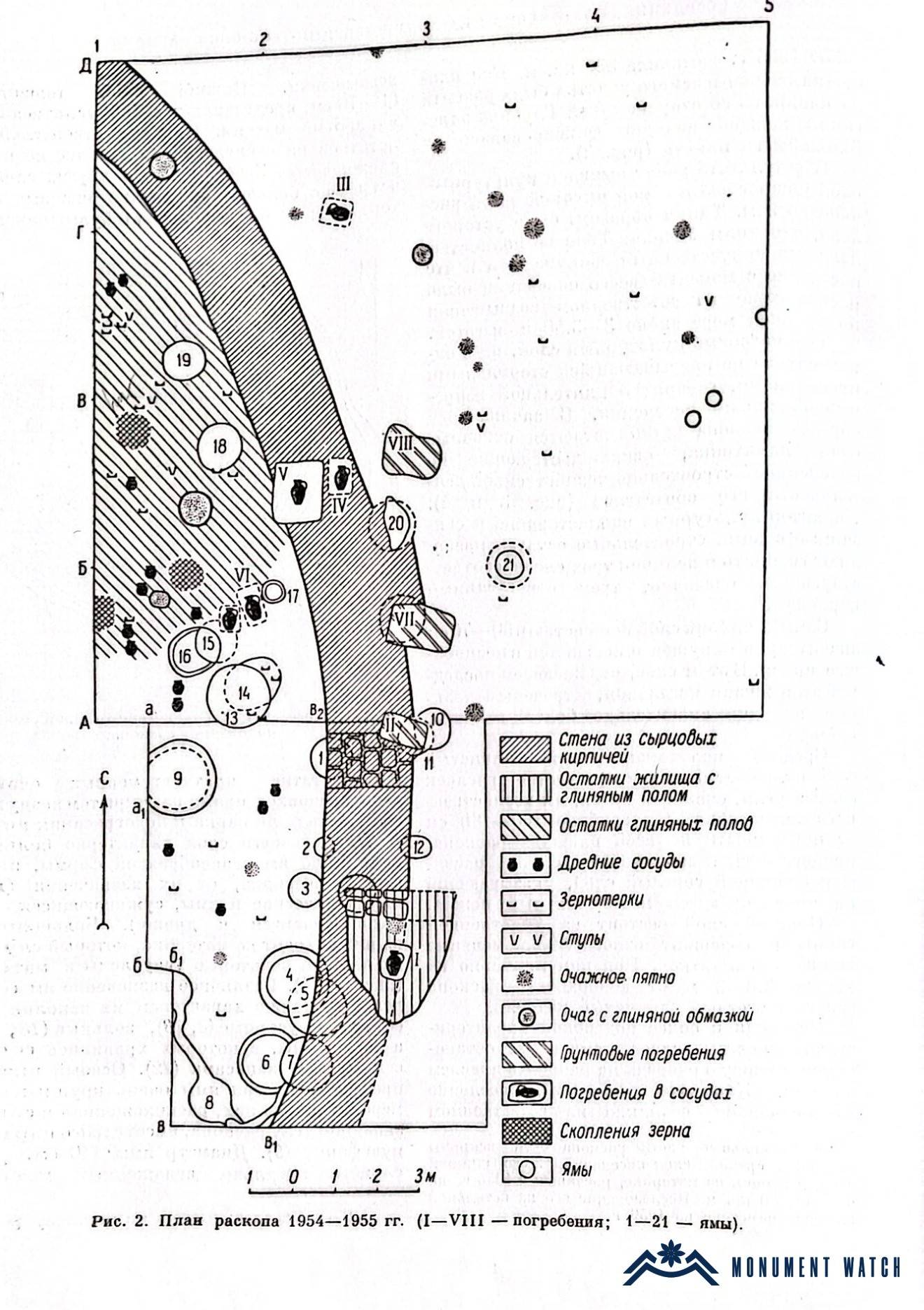
During the excavations of the Middle Bronze Age settlement of Uzerlik-tepe in 1954–1955, eight burials were discovered—four inhumation (earth/grave-pit) burials and four jar burials (Fig. 1). All of these burials were placed on the hill several centuries after the abandonment of the settlement. In three cases, the burials were inserted into a mudbrick wall belonging to the settlement.
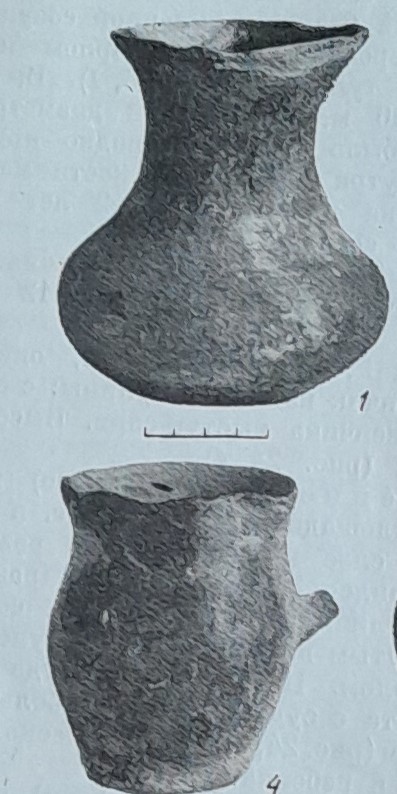
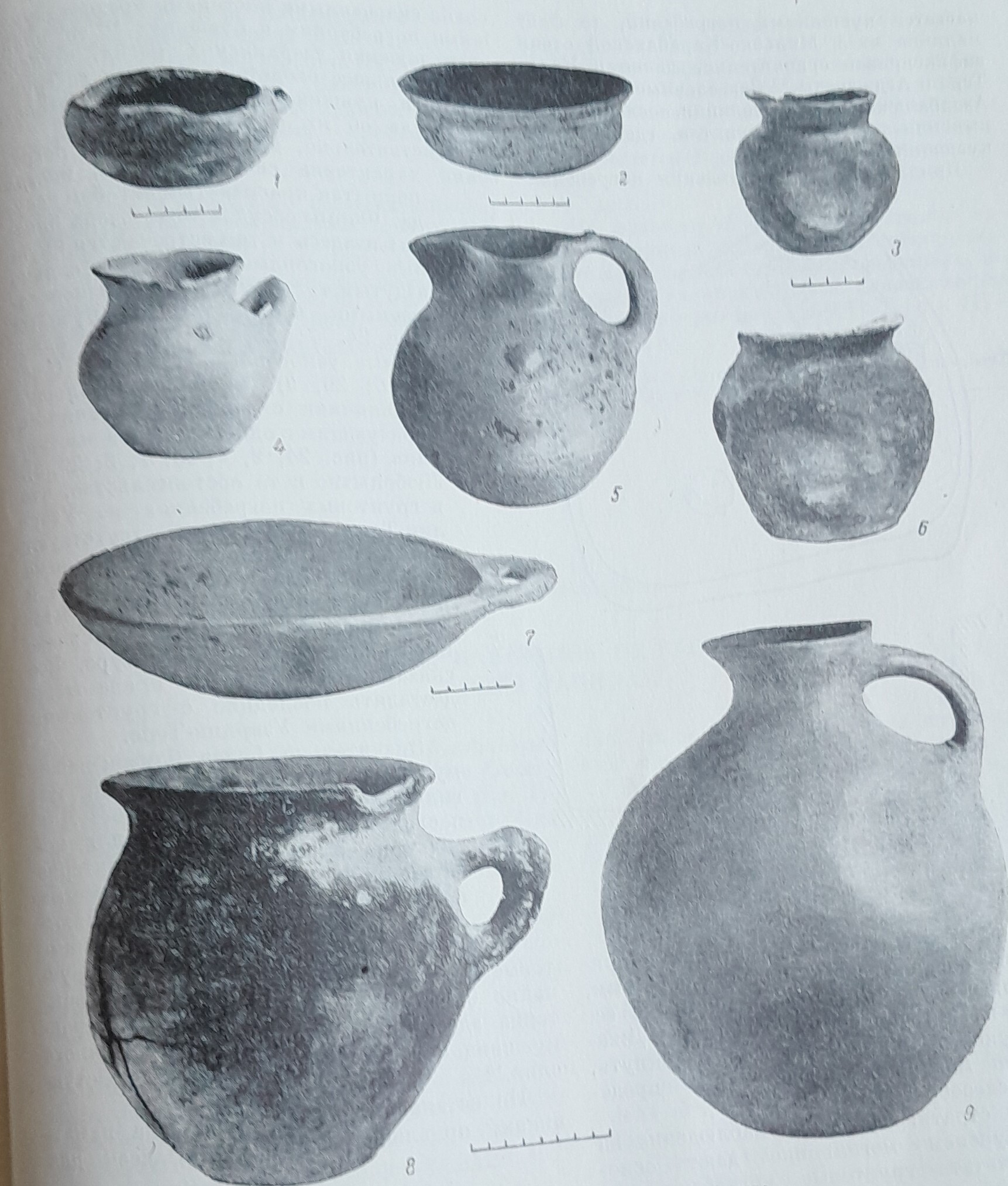
The first burial was found in the initial excavation area, within the section of a mudbrick wall. At a depth of 0.80–0.85 m below the surface, a large, light-colored, handleless vessel had been set in place. Inside were the poorly preserved bones of a small child (1–2 years old) mixed with ash and charcoal particles. The vessel also contained a small iron ring and a small black-burnished ceramic jug with a tall neck and an everted rim, without handles (Fig. 2/5, 8).
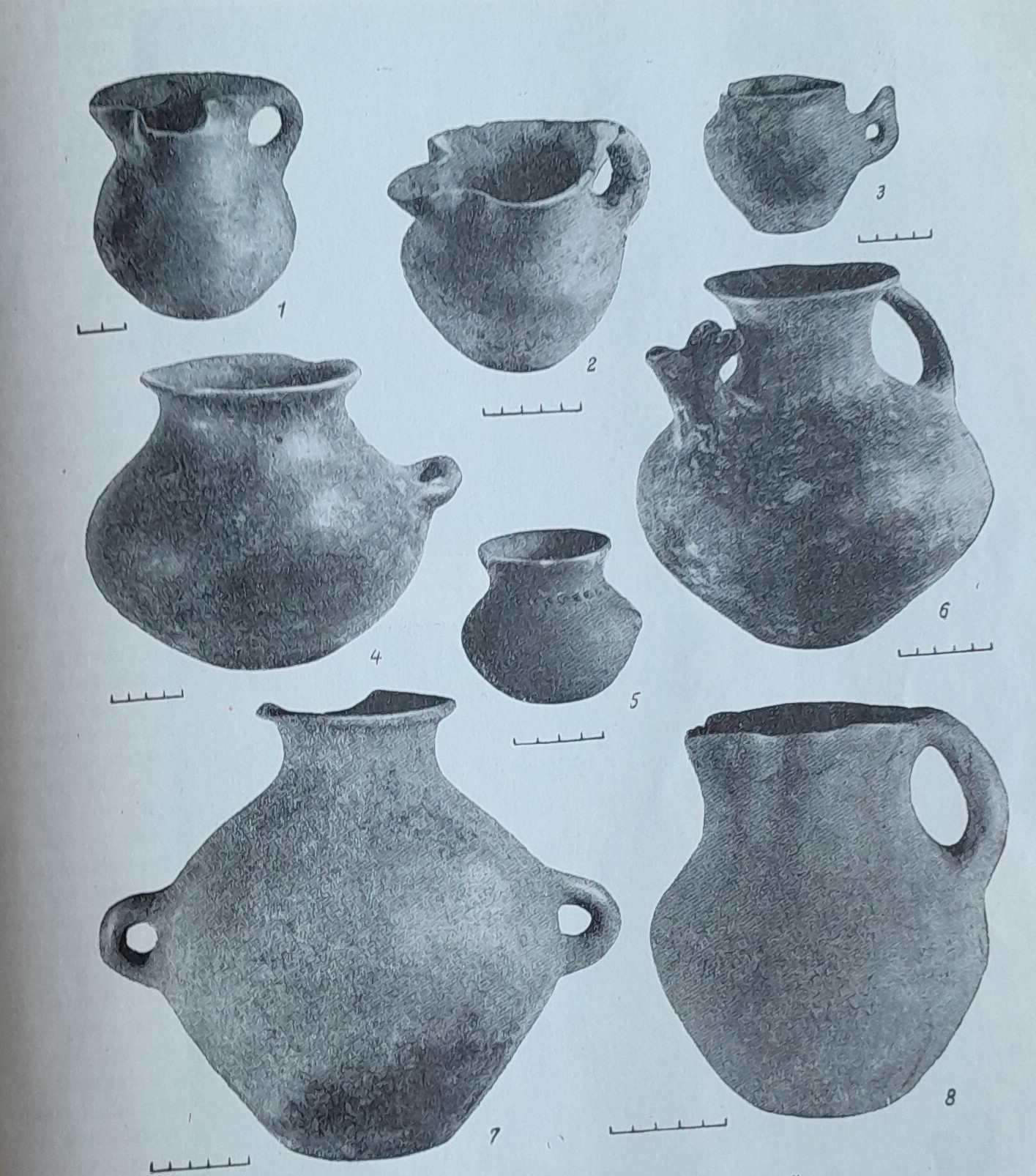
The second (inhumation) burial was discovered within the cut of the enclosing wall that was revealed during the 1954 and 1955 excavations. It was oriented west–east. Remains of wood in the grave indicate that it had been covered with logs. On the grave floor lay the skeleton of a child (3–5 years old) in a contracted position, on the left side, with the head to the west. The deceased wore an iron neck ring/torc, bronze lamellar pendants attached to a chain, paste beads, a shell pendant, and textile remains. Four vessels were placed in the grave (Fig. 10/1, 5, 6, 8).
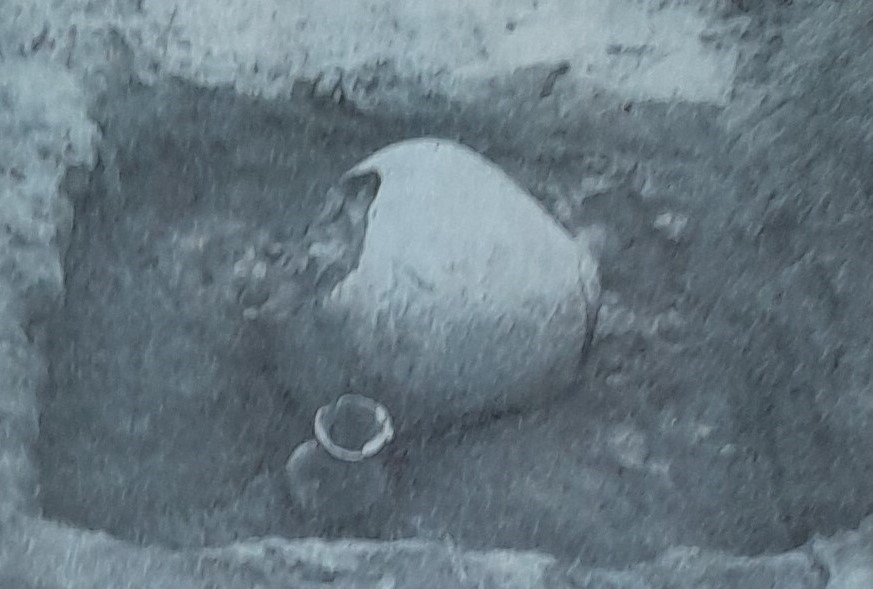
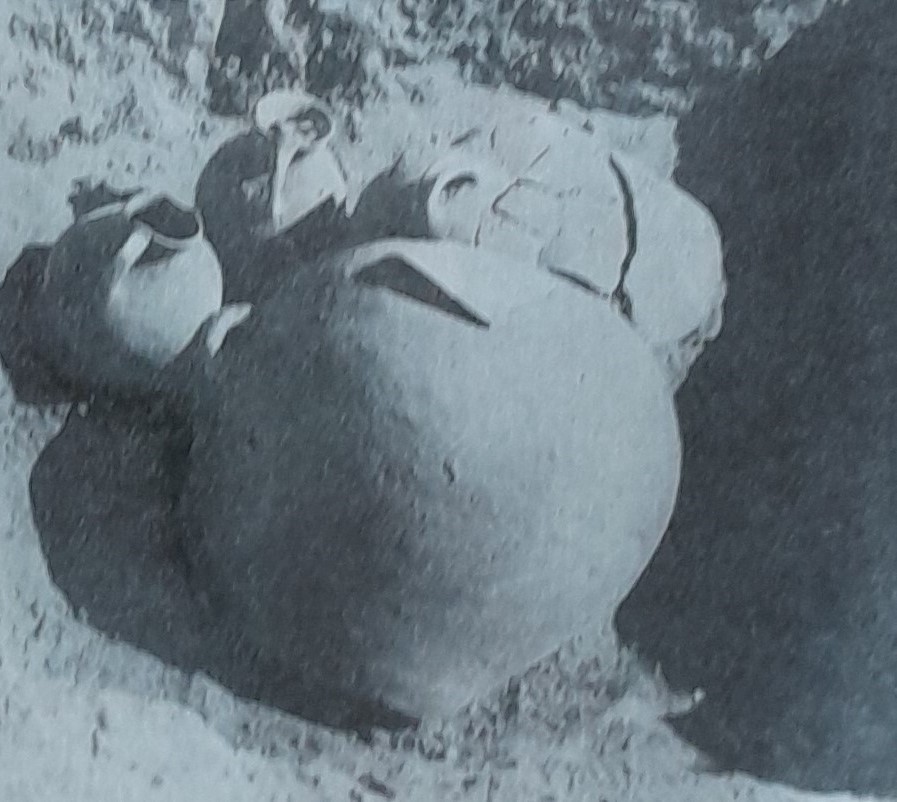
The third jar burial was located in the northern part of the 1955 excavation area. At a depth of 0.35 m below the surface, a large, handmade, handleless vessel with a bulging body had been laid on its side (Fig. 3). Inside were the bones of a child (1-2 years old) and two small vessels (Fig. 4).
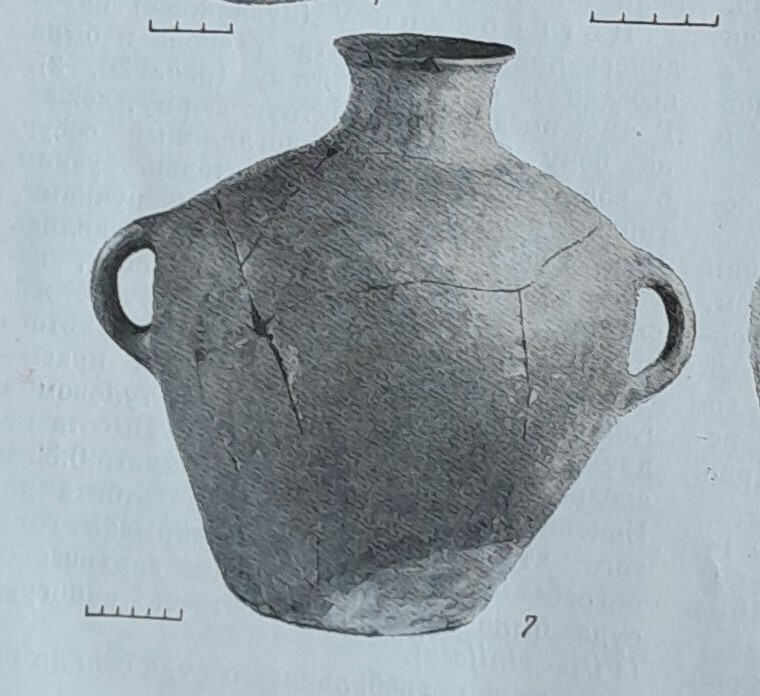
The fourth jar burial was found in the upper layer of the 1955 excavation area, in a heavily disturbed condition. Only the main burial container was preserved: a large, highly swollen-bodied, narrow-necked, light-colored, two-handled vessel. Its surface was burnished (Fig. 5).
The fifth jar burial was discovered in the central part of the excavation horizon, within the cut of a mudbrick wall. In a square-shaped pit, a large vessel with swollen ribs, a relatively narrow neck, and two vertical handles had been laid on its side (Fig. 6). Inside were children’s bones, several beads, and fragments of an iron implement curving inward (possibly a sickle). Around the burial vessel were several ceramic containers: narrow-necked, burnished vessels; a light-colored, one-handled jug; another one-handled jug with swollen ribs covered with a light red slip (angobe); a deep bowl; and a small one-handled jug (Kushnaryova 1959, 421) (Fig. 10/2, 3, 6).
The sixth inhumation burial was situated in the south-western part of the 1955 excavation area. Three vessels were placed among the poorly preserved human bones.
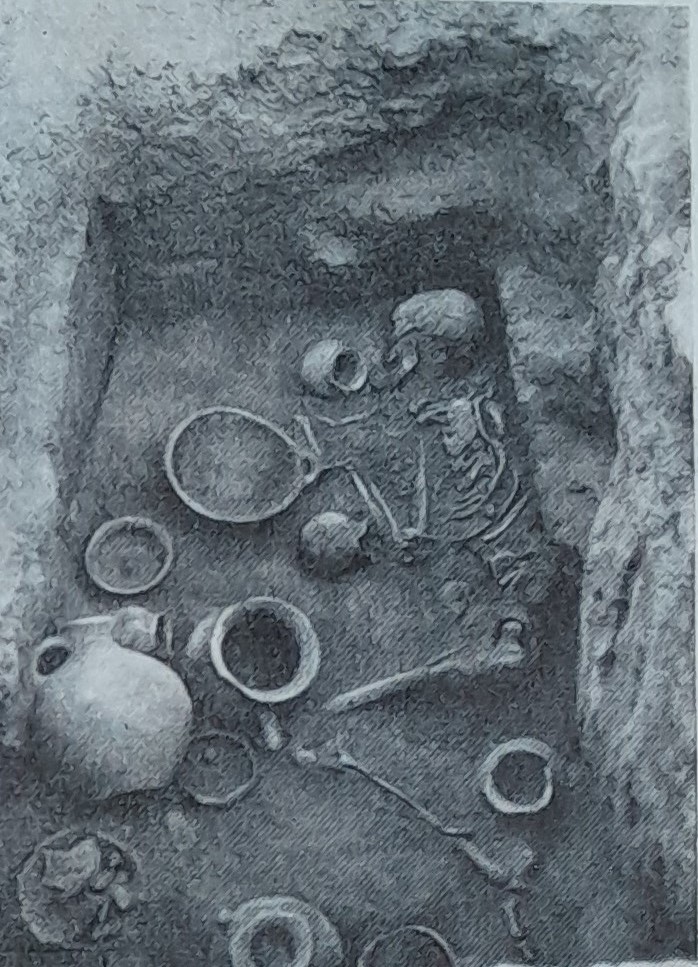
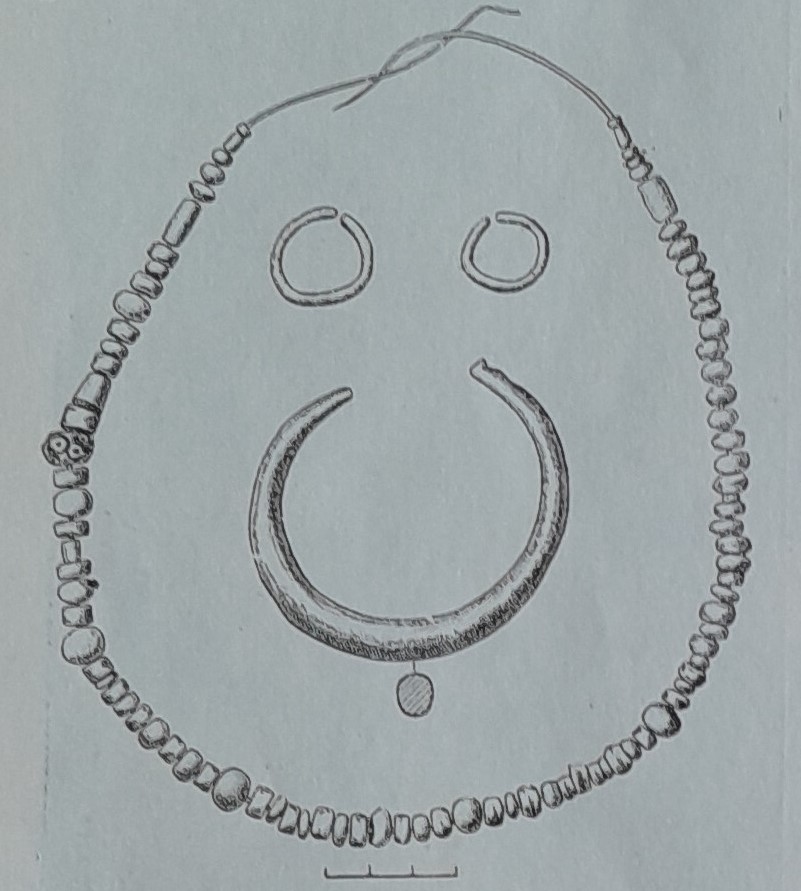
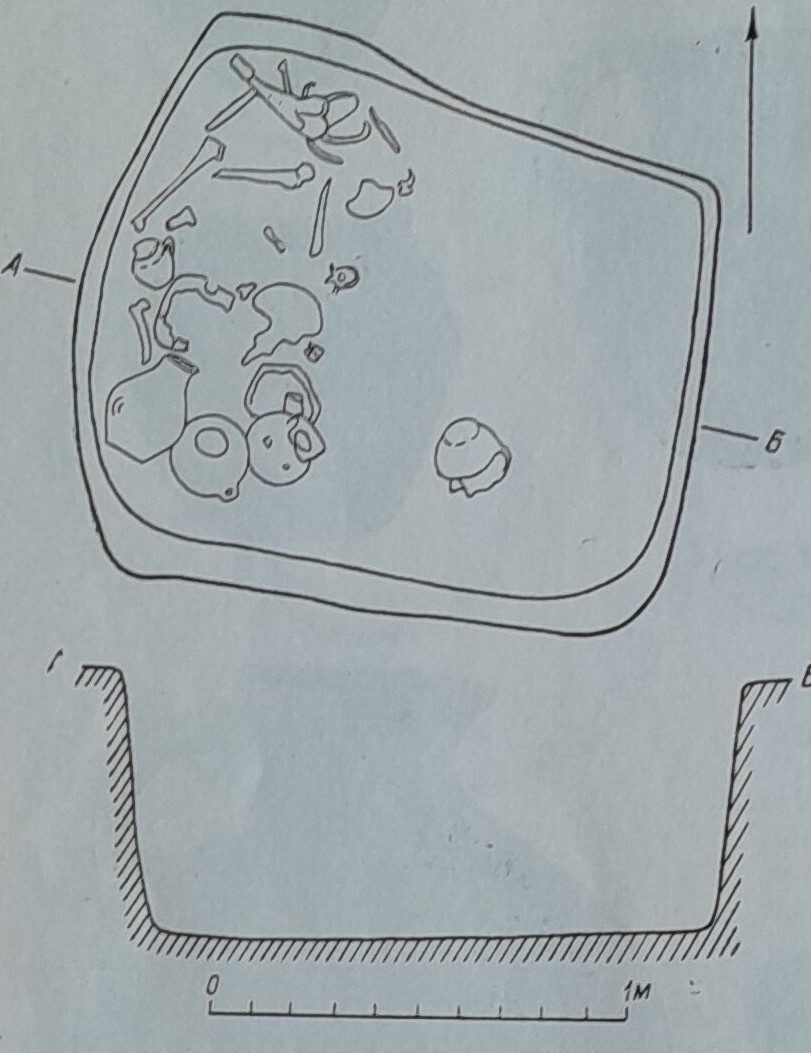
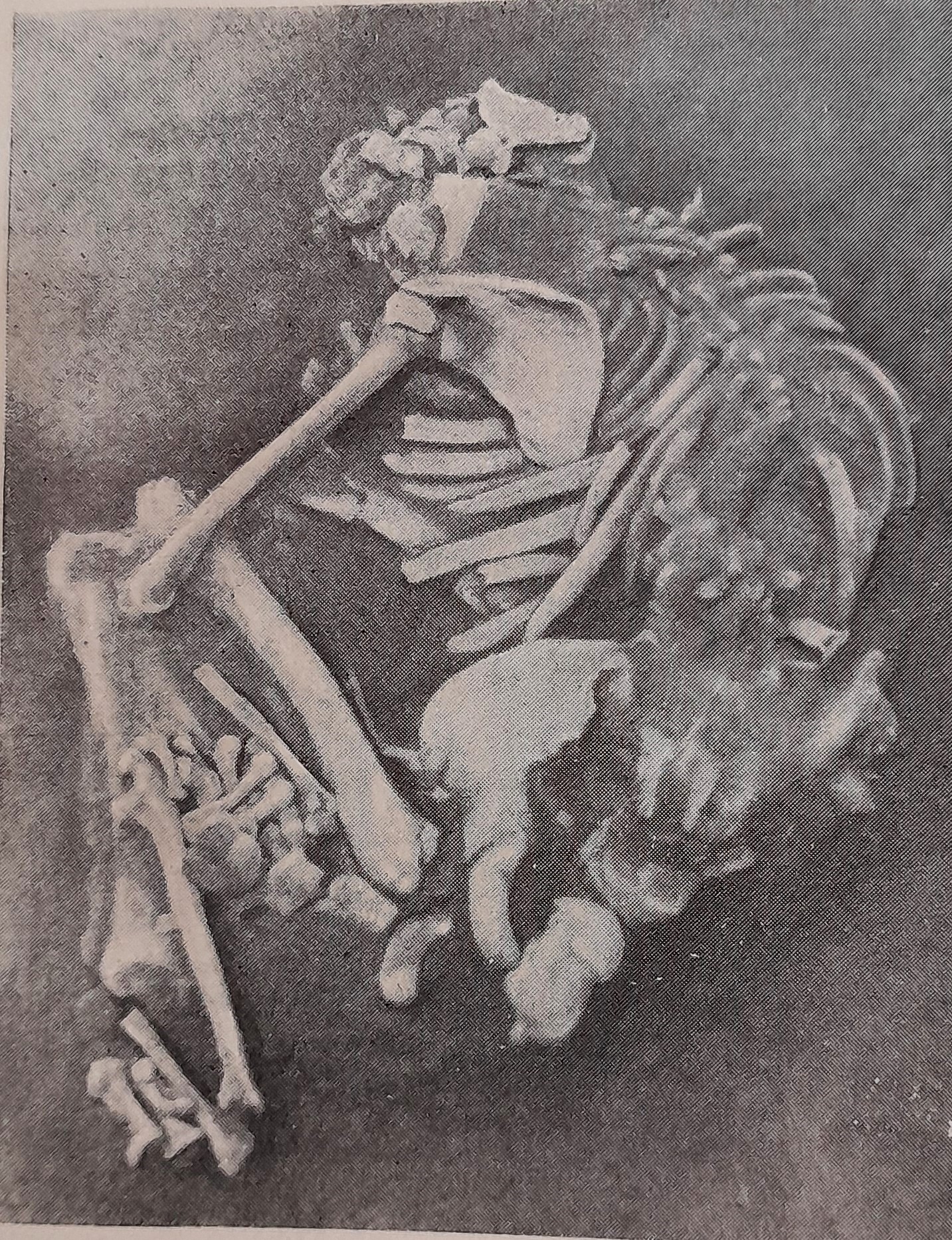
The seventh inhumation burial was located in the southern part of the 1955 excavation area, near the outer edge of the mudbrick wall. The grave was rectangular and oriented west–east. On the grave floor lay the skeleton of a woman, placed on the right side in a contracted position, with the head to the east (Fig. 7). A large quantity of bronze and carnelian (sard) beads was found in the chest area; bronze bracelets were on the arms; and bronze temple rings/earrings were found on the skull (Fig. 8). Thirteen vessels were placed throughout the remaining area of the grave (Fig. 11; Kushnaryova 1959, 425).
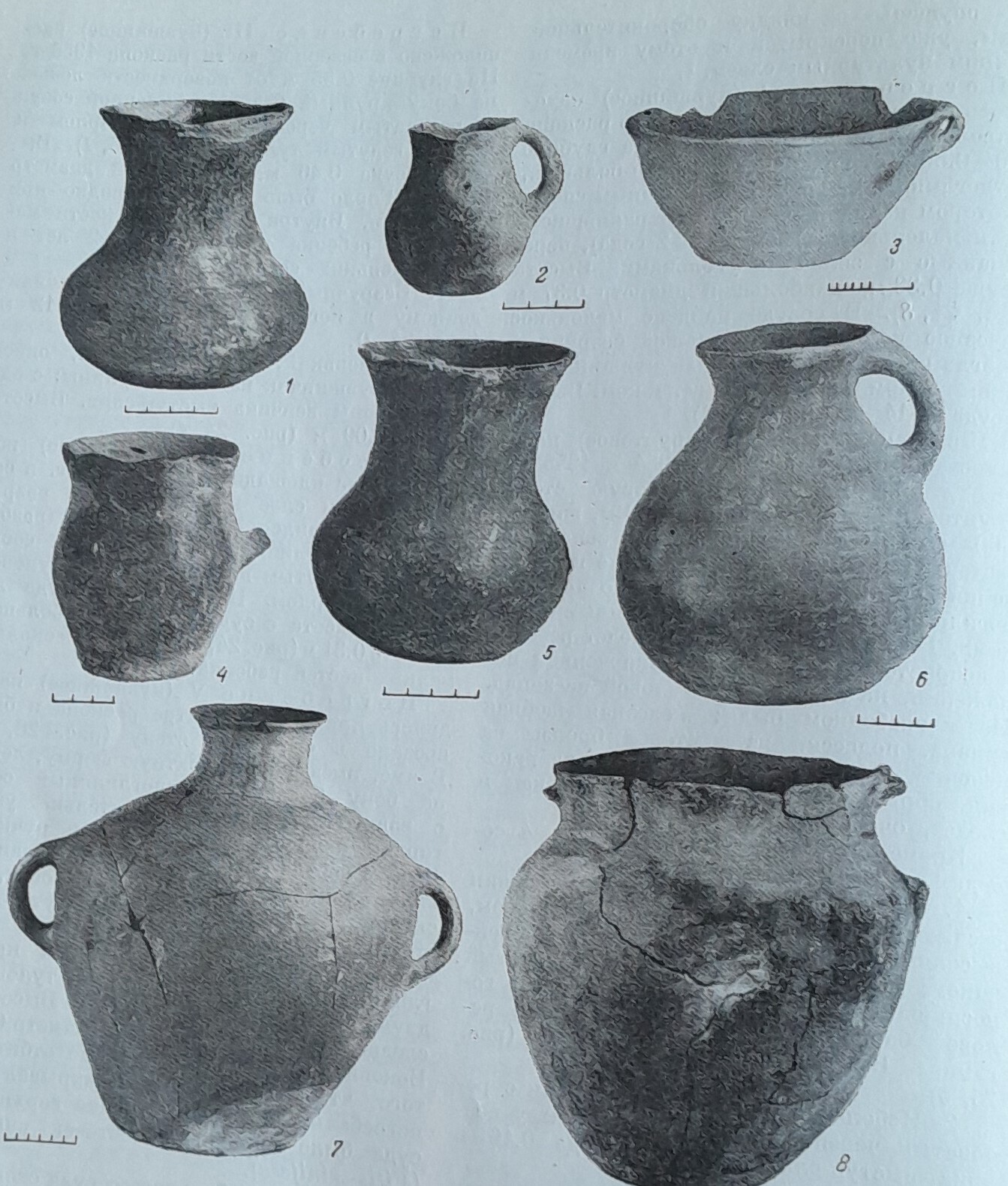
The eighth inhumation burial was found in the 1955 excavation area, along the outer edge of the mudbrick wall. The grave was rectangular and oriented west–east. The skeletal bones and seven vessels were scattered within the grave (Fig. 9; 2/2, 3, 4, 7; Kushnaryova 1959, 426, 428).
According to K. Kushnaryova, both the inhumation and jar burials belong to the same period. A characteristic feature of both types is grey-clay pottery, sometimes covered with a reddish slip (angobe). The vessel forms are likewise closely comparable: in both burial types, one finds large, narrow-necked vessels with strongly swollen bodies and two vertical handles; one-handled jugs with swollen bodies and narrow necks; and small jugs with trefoil mouths (Figs. 2, 10, 11).
In 1956, a further five burials (inhumation and jar burials) were excavated in the southern sector of the site (Kushnaryova 1965, 99–100) (Fig. 12).
The materials recovered from Uzerlik-tepe exhibit close parallels with finds from jar burials discovered in recent years in Artsakh, including those at Jarakatagh, Haterk, and Tigranakert (Artsakh Tigranakert 2025, 70–79, 114–129).
Kushnaryova dated the Uzerlik-tepe burials to the period from the 3rd century BCE to the 1st century CE (Kushnaryova 1959).
Bibliography
- Kushnaryova 1959 - Kushnaryova K., A Bronze Age settlement on the Uzerlik-tepe hill near Aghdam, Proceedings of the Azerbaijani (Oren-Kalin) Archaeological Expedition, vol. 1, 1953–1955, Materials and Research on the Archaeology of the USSR (MIA SSSR), no. 67, Moscow–Leningrad, pp. 388–430.
- Kushnaryova 1965 - Kushnaryova K., New data on the Uzerlik-tepe settlement near Aghdam, MIA SSSR, no. 125, Proceedings of the Azerbaijani (Oren-Kalin) Archaeological Expedition, vol. 2, 1956–1960, Moscow–Leningrad, pp. 74–102.
The Ancient burials of the Uzerlik-tepe settlement
Artsakh