


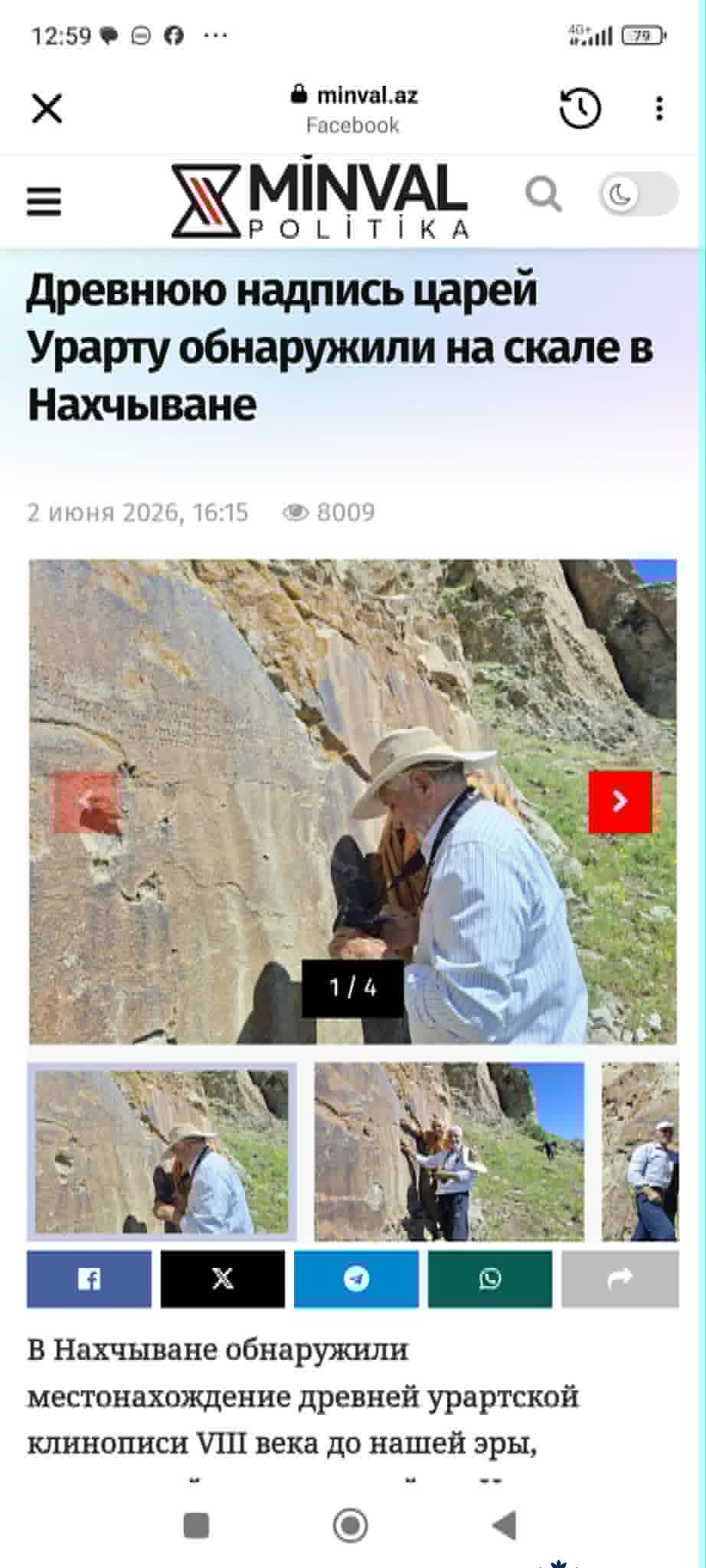
On the Urartian Inscription of Odzasar
In recent days, information has been circulating online, especially through various Azerbaijani media platforms, claiming that a cuneiform inscription relating to the joint reign of the Urartian kings Ishpuini and Menua has been found, or rediscovered, on Mount Odzasar in Nakhichevan.
In reality, the Urartian inscription of Odzasar was discovered in 1988 by V. Igumnov, Candidate of Geological Sciences and Director of the Seismochemistry and Analytical Center of the National Survey for Seismic Protection of the Republic of Armenia. In 1996, V. Igumnov, H. Karagyozyan, and S. Hmayakyan published an article in the Historical-Philological Journal concerning the Odzasar inscription and its reading. Later, prominent Urartologists N. Harutyunyan and M. Salvini also published articles on the inscription, introducing certain corrections to its reading. In recent years, the Odzasar inscription has also been addressed by the well-known Urartologist R. Dan, while the cultic aspects mentioned in the text have also been discussed by the author of these lines.
The inscription refers to the conquest by Ishpuini and Menua of the lands of the cities of Artsini and Aniani, the erection of a stele in honor of the god Khaldi, and the offering of animal sacrifices to Khaldi and to Khaldi’s wife.
Odzasar is located near the historical Armenian settlement of Khoshakunik.
Why, then, have Azerbaijanis begun circulating reports about the “discovery” of the Odzasar inscription precisely at this moment? Moreover, they are already claiming that the inscription attests to the presence of the Urartian state in Nakhichevan and are also referring to a frontier. This is a highly sensitive term and may have far-reaching implications.
Until recently, at the official level, Azerbaijanis prohibited any mention or writing about the presence of the Urartian state in Nakhichevan. Even the fragment of a typical Urartian pithos bearing a cuneiform inscription found at Oghlan-Kala was interpreted by them as a manifestation of local writing. They even attempted to compel foreign scholars working in Nakhichevan to state in their publications that there were no traces of Urartian presence in Nakhichevan. One vivid example of this is the report by the prominent American archaeologist Bradley Parker, titled “Azeri Nationalism and the Silencing of the Past,” in which the scholar included both his own text and a message addressed to him by an Azerbaijani correspondent, who attempted to convince Parker that the fortresses of Nakhichevan were not Urartian.
Apparently, however, a serious shift is now taking place.
Now, all of a sudden, we see that the Odzasar inscription has been “rediscovered” in Nakhichevan. The question arises: if they had really wanted to, could they not have found this inscription earlier? I believe, of course, that they could have. This leads to another question: why have they begun presenting this inscription and speaking about Urartian heritage in Nakhichevan precisely now?
At present, Azerbaijanis have begun promoting the claim that Armenians have no connection whatsoever with Urartu. In my personal opinion, these circumstances may indicate the beginning of a process — moreover, a planned process — aimed at taking Urartu away from us. If previously Turkey laid claim to Urartu, the Kingdom of Ararat, now Azerbaijan too appears to be making such a claim.
It is also very telling that in the disgraceful and error-filled map of Urartu included in the 7th-grade Armenian history textbook, the territory of the present-day Republic of Armenia is absent, Erebuni is not included, yet Nakhichevan is included.
Author: Mikayel Badalyan
(https://www.facebook.com/share/p/1B96fPQqHP/?mibextid=wwXIfr)