


“Dialog” NGO: Artsakh’s Tigranakert: Historical and Cultural Profile in the Light of Archaeological Research to Be Presented to Russian-Speaking Readers
Back in May, Yuri Navoyan, president of the Dialog NGO, and Hamlet Petrosyan, Head of the Department of Cultural Studies at Yerevan State University and head of the independent academic platform Monument Watch, signed a cooperation agreement, joining efforts to monitor and academically describe the condition of Artsakh's cultural heritage.
This partnership has led to another thematic initiative: a new agreement between Yuri Navoyan and Hamlet Petrosyan concerns the publication in Russian of the research materials from the excavations of Artsakh's Tigranakert.
Professor Hamlet Petrosyan was the head of the archaeological research at Tigranakert, which became the most significant archaeological project in the history of Artsakh. The results of the excavations of one of the four Tigranakert cities founded by Tigran II the Great are presented in the study "Artsakh's Tigranakert: Historical and Cultural Profile in the Light of Archaeological Research", which is currently being prepared for publication in Armenian.
According to the signed agreement, with the support of Dialog, the book will be translated into Russian and published within a dedicated book series, thus making it accessible to a broader readership.
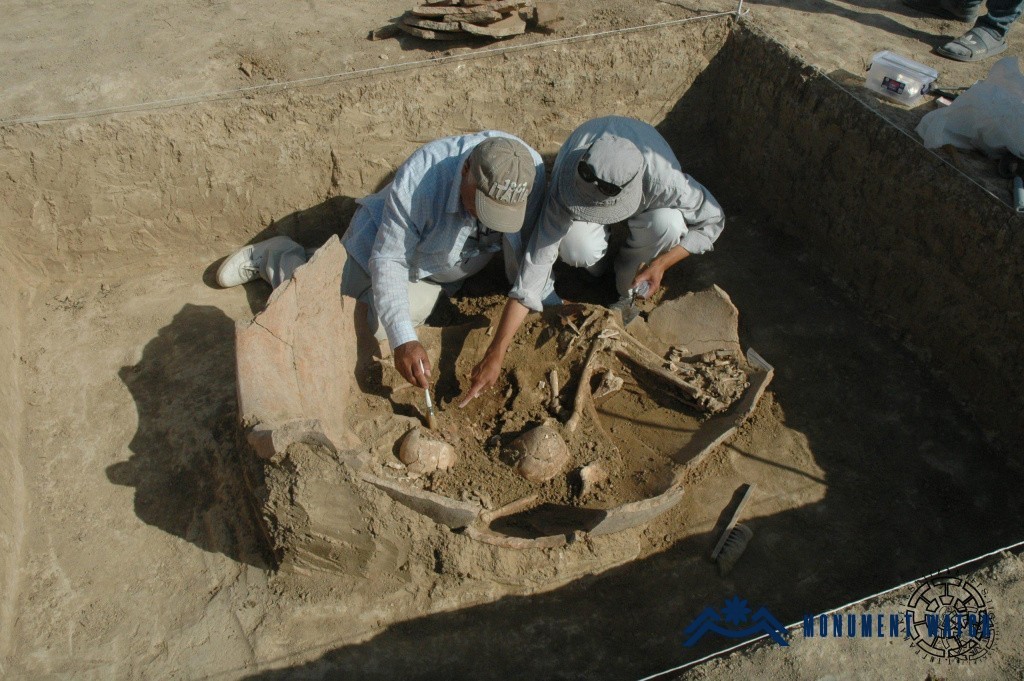
Artsakh's Tigranakert: Historical and Cultural Profile in the Light of Archaeological Research is an in-depth study of the ancient city of Tigranakert located in the Askeran district of Artsakh (Nagorno-Karabakh). This late Hellenistic city, founded by Tigran II the Great in the 1st century BCE, was discovered in 2005 and excavated between 2006 and 2020 by an archaeological expedition of the Institute of Archaeology and Ethnography of the National Academy of Sciences of Armenia.
The book offers a detailed examination of the archaeological finds that reveal the distinctive urban culture of Tigranakert, including a triangular district fortified with zigzag walls, residential quarters, burial grounds, and early Christian churches and their complexes. Special attention is paid to construction techniques and architectural solutions that make Tigranakert a key reference point for Hellenistic architecture in the region.
The book's authorship includes 21 leading scholars who directly participated in the excavations and the analysis of the discovered artefacts and materials. They also turn to written sources—starting with the references of the Greek geographer Strabo and the Armenian historian Sebeos—which confirm the city's historical significance. The excavations have revealed a rich cultural layer filled with everyday objects, jewellery, seals, and ceramics, attesting to Tigranakert's important commercial and administrative role in antiquity.
A special section of the book is devoted to the threats to Artsakh's cultural heritage arising from recent military developments and the distortion of historical facts.
The scholars expose attempts by Azerbaijani specialists to rewrite history by presenting Tigranakert as an "Albanian" city and attributing Armenian monuments to other cultures. This phenomenon is examined as part of a broader, systematic propaganda campaign unfolding in the region.
The purpose of the publication is to draw attention to the preservation and dissemination of Artsakh's Armenian cultural heritage, to emphasize the need for an accurate representation of the region's history, and to highlight the importance of countering falsified historical narratives.
The book will be a significant contribution to the study and protection of Tigranakert's historical and cultural image as a unique monument of ancient Armenian civilization.
https://dialogorg.ru/events/kniga_-artsakhskiy_tigranakert-_istoriko-kulturnyy_oblik_v_svete_arkheologicheskikh_issledovaniy-_pr/