


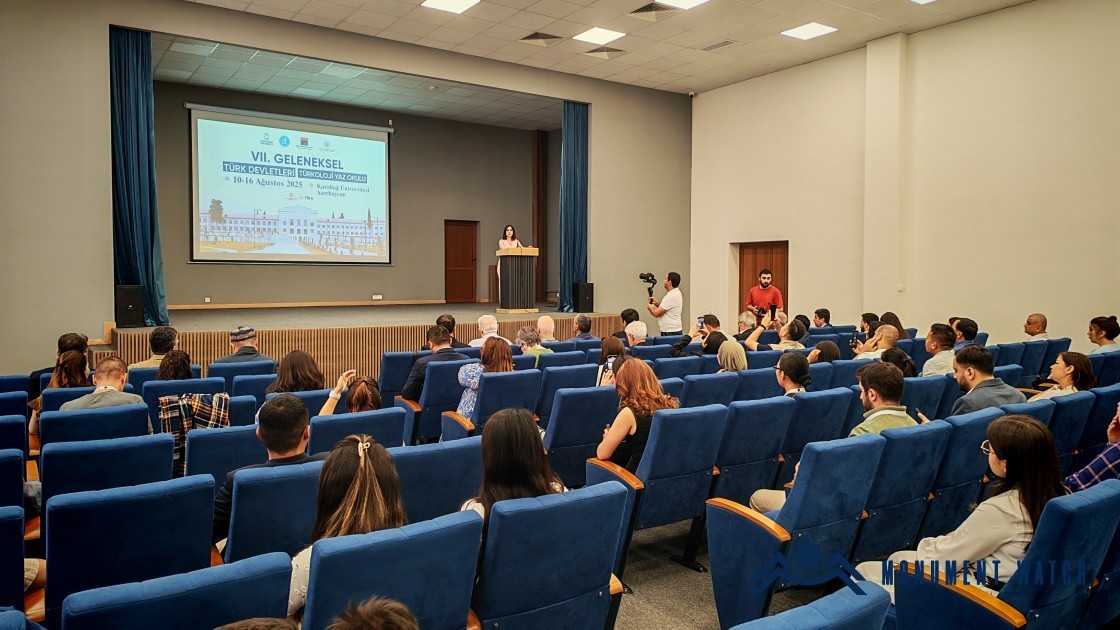
The “Turkology Summer School” launched in Stepanakert
From 10 to 17 August 2025, the 7th Turkology Summer School is being held in the city of Stepanakert, at the Karabakh University opened in the former building of Artsakh State University. The initiative is carried out through cooperation between Karabakh University, the International Turkic Academy, and the Turkish Academy of Sciences. According to their joint statement, the programme aims to strengthen the professional capacity of young scholars in the field of Turkological research, promote the exchange of knowledge and experience among representatives of different countries, and provide an opportunity to study contemporary academic approaches and practical methods.
Despite its presented scholarly character, the event’s actual purpose is the promotion of a pan-Turkic cultural and political agenda in the region. Participants include 32 young scholars and doctoral students from Azerbaijan, Turkey, Kazakhstan, Kyrgyzstan, Uzbekistan, Mongolia, Northern Cyprus, and North Macedonia. The courses are delivered by 15 lecturers arriving from Azerbaijan, Turkey, Kazakhstan, Kyrgyzstan, and Uzbekistan. The announced programme includes classes in linguistics, literary studies, history, ethnography, and cultural studies, as well as thematic discussions. This event serves both to strengthen existing academic ties among the participating countries and to shape the Turkic world’s shared scientific future.
The opening ceremony took place on 11 August in the former building of Artsakh State University. Speeches were delivered by the university’s rector, Shahin Bayramov, the president of the Turkic Academy, Shahin Mustafayev, and the president of the Turkish Academy of Sciences, Muzaffar Şeker. In his speech, Shahin Bayramov stated that, after the “liberation” of lands that had been under occupation for years, Karabakh is being revived not only economically and socially, but also through its scientific and cultural potential. According to him, the Karabakh University, opened in 2024, is taking important steps not only as a higher education institution, but also toward becoming a regional scientific and intellectual centre. The rector emphasized that Karabakh’s rich historical heritage and strategic geographical position make it an important platform for scientific cooperation for the Turkic world. In his view, this university will play a role in the Turkic world by forming the scientific foundation for joint development. The rector stressed that integration in science and education—anchored in common historical roots—is the most reliable guarantee of strategic cooperation, and that the event will make a significant contribution to the recognition of Karabakh University in the Turkic world and to the development of scholarly cooperation among scientists and young researchers from Turkic states. As it becomes apparent, in their conception, a shared Turkic heritage is rooted precisely in the soil of occupied Artsakh (https://azertag.az/xeber/qarabag_universiteti_7_ci_turkoloji_yay_mektebine_ev_sahibliyi_edir__yenilenib__video-3695679?fbclid=IwY2xjawMJTaBleHRuA2FlbQIxMABicmlkETFjSTdzaGg2QW9LOTNzMEE3AR7qiBJwzCu3y1Nm1BYqq3wXn6CARIvxqxeGCyHRyIke05ELaLpXmQ-nyR_iIw_aem_jIvwuD4B1puk_TbZl6kcwA).
The statements voiced during the opening ceremony about the “scientific integration of the Turkic world” and “common values” in effect signify a policy by Azerbaijan and Turkey to form a joint cultural space, including in Nagorno-Karabakh. In particular, it was emphasized that Karabakh University should become the region’s “scientific and intellectual centre,” which is directly linked to the strengthening of their agenda in territories controlled by the Azerbaijani authorities.
The summer school was organized with the support of the Ministry of Science and Education of Azerbaijan, the Ministry of Culture and Tourism of Turkey, and the Turkish Cooperation and Coordination Agency (TİKA). Previously, the Turkology Summer School was held in Turkey, Kyrgyzstan, and Kazakhstan (https://karabakh.edu.az/page/64/578).