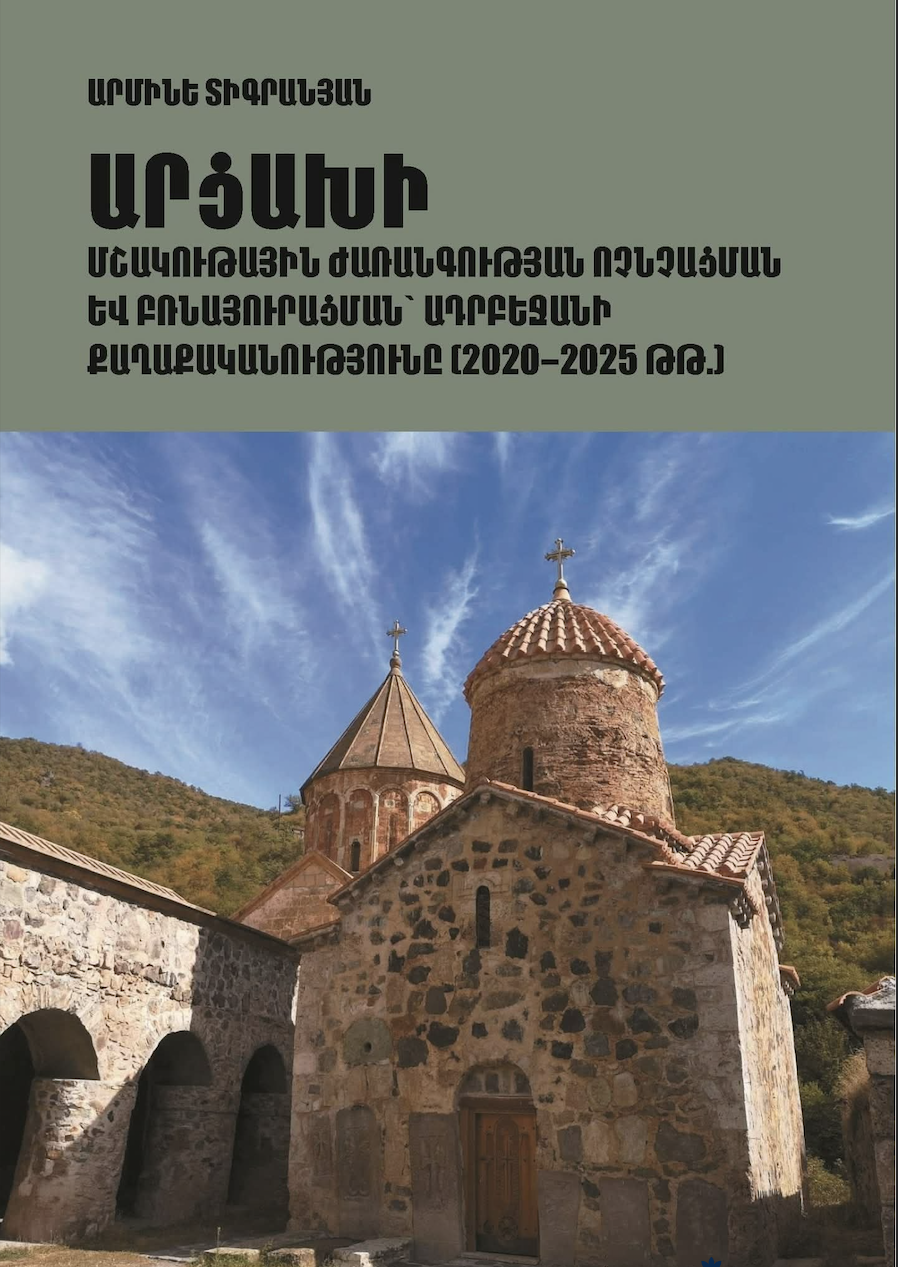
In this study, the author addresses Azerbaijan’s policy of systematic destruction and appropriation of Artsakh’s historical Armenian cultural heritage as a consequence of the wars unleashed by Azerbaijan in 2020–2025, ethnic cleansing, and racial discrimination, as well as the international mechanisms for the protection of cultural heritage.
The monograph examines the international system for the protection of cultural property in the event of armed conflict; the cases of unlawful targeting of Artsakh’s Armenian cultural heritage by Azerbaijan during and after the 44-day war, viewed from the perspective of international principles; and the methods of its destruction and appropriation. It presents the international regulatory framework, as well as the legal and humanitarian instruments for the protection of cultural property — including international conventions, declarations, resolutions, statutes, and customary norms — in defense of Artsakh’s Armenian cultural heritage vandalized by Azerbaijan.
The study of academic articles, books, UNESCO, UN, ICOMOS, Council of Europe, and European Parliament resolutions, the Rome Statute, and relevant theoretical and legal documents has made it possible to identify ways of protecting Artsakh’s cultural heritage within the framework of the preservation of universal human values, the application of international humanitarian law regardless of the political situation, and respect for cultural rights.
The monograph is intended for specialists engaged in the preservation of cultural heritage, state institutions, academic organizations, students, and a broad readership concerned with the protection and preservation of the cultural heritage of the Armenians of Artsakh.
It was published by the Publishing House of the Mother See of Holy Etchmiadzin.