


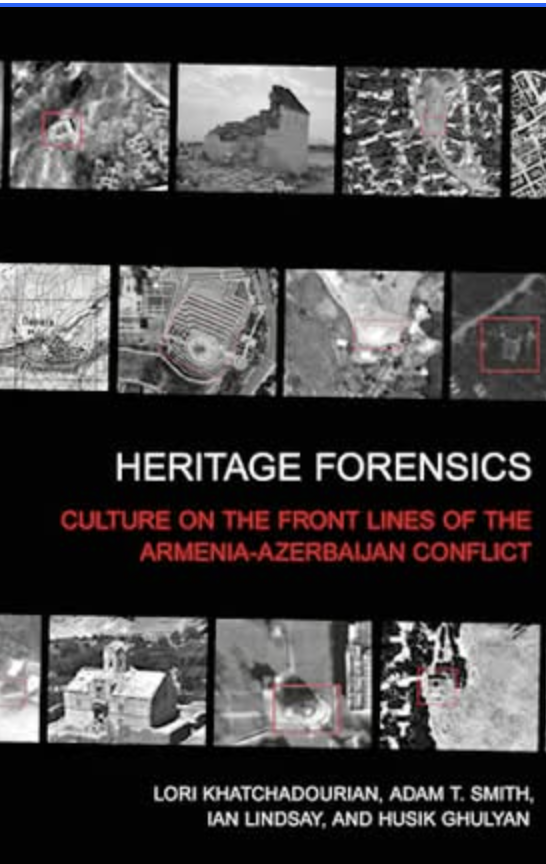
New Publication: Heritage Forensics: Culture on the Front Lines of the Armenia-Azerbaijan Conflict
Cornell University Press has published Heritage Forensics: Culture on the Front Lines of the Armenia-Azerbaijan Conflict, authored by Lori Khatchadourian, Adam T. Smith, Ian Lindsay, and Husik Ghulyan.
The book consists of an introduction and four main chapters addressing the destruction and appropriation of cultural heritage, as well as innovative methods for its investigation:
- “Silent Erasure”
- “Heritage Mining”
- “Techniques, Technologies, Thresholds”
- “Counter-Forensics on the Cultural Front”
The volume examines the role of cultural heritage in contemporary conflicts, approaching it as a domain of historical memory, identity, political processes, and legal protection. The authors trace the formation and development of the international system for the protection of cultural heritage, from the legal mechanisms established in the aftermath of the Second World War to the instruments of contemporary international criminal law. At the same time, they emphasize that in situations of protracted and unresolved conflict, existing legal frameworks often fail to prevent the destruction and appropriation of cultural heritage effectively.
The central concept of the book is the innovative approach of “heritage forensics,” which treats the investigation of violations against cultural heritage as a process of collecting, analyzing, and substantiating evidence. This methodology combines satellite imagery analysis, digital technologies, the study of historical sources, and tools of humanistic research, enabling documentation of cases of destruction, damage, or endangerment of cultural heritage, including in inaccessible areas.
Particular attention is devoted to the Nagorno-Karabakh conflict as an important case study in the field of cultural heritage protection. The authors examine the development of the conflict from 1988 through the events of 2023, demonstrating how cultural heritage became a central component of historical memory, identity, and political contestation in the region. Under the conditions of the “frozen conflict” that emerged after 1994, attitudes toward heritage continued to reflect the historical and political narratives of the conflicting parties. The 44-day war of 2020, the blockade of 2022, and the military operations of 2023 are presented as events that profoundly affected the region’s cultural landscape and the Armenian people’s ties to it.
An important section of the book is devoted to Caucasus Heritage Watch (CHW), an initiative established in 2020 to conduct independent and evidence-based monitoring of cultural heritage in the context of the Armenian-Azerbaijani conflict. CHW’s work is based on interdisciplinary research methods, including the analysis of satellite imagery, geospatial analysis, and historical and archaeological research.
The initiative’s studies seek to document actions affecting cultural heritage and to create scientifically grounded evidence for public awareness and potential legal proceedings.
Heritage Forensics: Culture on the Front Lines of the Armenia-Azerbaijan Conflict places the study of cultural heritage on a new evidentiary and interdisciplinary footing, demonstrating that in situations of conflict, heritage protection is closely connected with the preservation of historical memory, the protection of cultural rights, and the development of mechanisms of international accountability.
The book’s first chapter, “Silent Erasure,” examines forms of cultural heritage destruction carried out through the physical disappearance of heritage, the restriction of its historical visibility, and the systematic reshaping of memory. The authors present cultural heritage as a sociocultural phenomenon of a public nature, whose existence and significance depend on social recognition, the formation of historical consciousness, and mechanisms of legal protection. From this perspective, violence against heritage takes the form not only of the destruction of material objects, but also of the exclusion of their historical presence, affiliation, and memory.
The chapter examines the elimination of Armenian cultural heritage in the Nakhichevan Autonomous Republic of Azerbaijan between 1997 and 2010. The authors analyze the political, historiographical, and legal contexts of the systematic destruction of Armenian churches, monasteries, khachkars, cemeteries, and other cultural sites. They demonstrate that this process was not limited to the physical removal of individual monuments, but also involved administrative and ideological mechanisms through which the Armenian cultural presence was excluded from the historical context of the region.
Through the concept of “silent erasure,” the authors characterize a strategy of cultural heritage elimination in which destruction may occur gradually, with limited public visibility and under conditions of minimal international oversight. The case of Nakhichevan is presented as a state-organized process of cultural transformation, as a result of which the Armenian historical and cultural presence in the region was almost entirely erased.
The chapter also pays particular attention to the limitations of the international legal system for cultural heritage protection. The authors emphasize that when heritage destruction takes place through long-term and often concealed processes, establishing legal responsibility becomes considerably more difficult. In this context, the methodology of heritage forensics is presented as a scholarly tool that makes it possible to combine historical sources, technological data, and spatial analysis in order to document violations against cultural heritage and preserve historical evidence.
The second chapter, “Heritage Mining,” examines forms of the economic exploitation of cultural heritage under conditions of war, broadening conventional understandings of heritage destruction. The authors demonstrate that damage to cultural heritage during conflict is not limited to the looting and illicit trafficking of archaeological objects, but may also involve the extraction of material resources, the economic appropriation of cultural sites, and their transformation into sources of profit.
The key concept of the chapter is “heritage mining,” by which the authors describe the process of economically exploiting the material components of cultural heritage. This phenomenon is presented as a particular manifestation of a wartime economy, within which heritage sites are stripped of their historical, religious, and cultural significance and transformed into exploitable material resources. The authors emphasize that such processes may include the removal of building materials, metal components, or other reusable materials, as well as the appropriation of cultural spaces for economic purposes.
The third chapter, “Techniques, Technologies, Thresholds,” is devoted to the formation and practical significance of the heritage forensics methodology. The authors present it as a new mode of knowledge production that combines technological tools, research methods, and collaboration across different professional fields in order to investigate violations against cultural heritage.
The chapter emphasizes that heritage forensics makes it possible to transform damage to cultural heritage into documented evidence that can be used in public, legal, and political arenas. This approach brings together researchers, lawyers, human rights defenders, journalists, and local communities with the aim of documenting violence against cultural heritage, creating evidentiary records, and contributing to the development of mechanisms of accountability.
The authors devote particular attention to the methods developed by Caucasus Heritage Watch (CHW), demonstrating how satellite imagery, digital technologies, and interdisciplinary analysis are used to investigate endangered cultural heritage in the context of the Armenian-Azerbaijani conflict. The chapter presents heritage forensics as a contemporary research tool that connects cultural heritage protection with facts, evidence, and processes of international accountability.
The introductory section of the fourth chapter, “Counter-Forensics on the Cultural Front,” examines how satellite-monitoring technologies—historically associated with state surveillance and the establishment of hegemonic power—can, in the hands of civil society and research groups such as Caucasus Heritage Watch (CHW), be transformed into a form of counter-forensics: a powerful tool for exposing state violence and cultural erasure.
The authors demonstrate that the interpretation of satellite imagery within the civilian sphere becomes a matter of open public scrutiny and evidentiary verification, allowing technology to directly serve the protection of human rights. In particular, it enables the documentation and prevention of the destruction of Armenian historical and cultural heritage in territories that have come under Azerbaijani control, including Nagorno-Karabakh and Nakhichevan.
Despite personal attacks against CHW by Azerbaijani state propaganda and unfounded accusations that its satellite images have been “Photoshopped,” the researchers respond through full transparency and verifiable evidence, demonstrating that technologically based documentation of this kind can effectively challenge state denial and help protect the cultural rights and dignity of forcibly displaced populations.
The book is available at: