


The campaign to appropriate Armenian carpets has now reached the Netherlands
Azerbaijan’s policy of appropriating Armenian heritage has recently intensified across various international platforms—including the Netherlands, Latvia, Poland and the Vatican—through exhibitions, conferences, lectures and so‑called “scientific” hearings.
This time the target of the cultural appropriation policy was the Netherlands, and once again Armenian carpets. The exhibition titled “The Splendour of Azerbaijani Carpets: Learning Through Art” held in the Atrium City Hall (Atrium Den Haag) of The Hague City Hall from 15 May to 20 June is a vivid example. The exhibition was organised by the Azerbaijani Embassy in the Netherlands and other state institutions (https://azertag.az/xeber/niderlandda_azerbaycan_xalchalarinin_mohtesemliyi_senet_vasitesile_oyrenmek_movzusunda_xalcha_sergisi_achilib_video-3571179).
The signs, animal and bird images, compositional patterns in the decorative design, and the beliefs surrounding them that appear in carpets presented as Azerbaijani are elements of Armenian carpet‑weaving culture with a history spanning centuries. The carpets shown in The Hague are products of the Azerbaijani company Azərxalça (Azerkhalcha), the sole carpet manufacturer in Azerbaijan. This indicates that the creation of collections reproducing Artsakh ornaments is guided by a monopoly and state patronage. The company’s samples replicate the Artsvagorg (“Eagle”) carpets from the carpet‑making centre of Jraberd in Artsakh and carpets of the Vorotan type from the Goghtn province of Syunik and Nakhichevan, as well as Shirvan carpets.
Some of the carpets in the exhibition, particularly those displayed under the title “Karabakh carpets,” are officially said to belong to the Azerbaijani carpet‑making school. Yet historical and ethnographic evidence shows that Karabakh has for centuries been a vibrant centre of Armenian culture and carpet‑weaving. Armenians were the indigenous and permanent inhabitants of this region, producing diverse carpet art while developing various aesthetic schools such as the carpet‑weaving traditions of Shushi, Varanda, Jraberd and Kashatagh. These carpets are distinguished by their high‑quality colour compositions, complex pattern systems and symbolic historical‑philosophical motifs (https://www.nidoragir.com/2025/03/1_21.html?fbclid=IwY2xjawLUgd1leHRuA2FlbQIxMQABHrEnef7rIVwsMgIr-K3DN95ifYrpa0Ysuym8xEMbfY5ad_sV4Fj6ScWQCLlE_aem_2Rz84jYn1tpjTeaDnuCw9A).
The Hague exhibition is not only a display of art appropriated from Armenians but also a politically charged event whose long‑term aim is to rewrite history, erase the Armenian identity and heritage of the Nagorno‑Karabakh region, and fix these changes on the international stage. It raises serious concerns about the preservation of cultural heritage and the ethical nature of the exhibition.
A similar exhibition was held in Latvia in 2024 at the Museum of Decorative Art and Design under the title “Azerbaijani Carpets: The Genetic Code of Memory.” The main display again included Armenian carpets from the Nagorno‑Karabakh and Armenian regions.
Our response
The people of Artsakh, with their rich carpet‑weaving traditions, are currently deprived—through forced displacement—of the opportunity to continue this cultural practice and contribute to the cultural life of their community. This constitutes a severe violation of the right to culture, as outlined in Article 27 of the Universal Declaration of Human Rights and Article 15 of the International Covenant on Economic, Social and Cultural Rights. On one hand, Azerbaijan has halted the practice of carpet‑weaving among the Armenians of Artsakh through forced deportations. On the other, it has deprived them of the chance to enrich and preserve their intangible heritage.
The carpet exhibition in the Netherlands represents a covert yet dangerous appropriation of Armenian cultural heritage. By distorting historical facts, Azerbaijan undermines the genuine tradition of this heritage and strips it of authenticity. This violates UNESCO’s principle of authenticity; according to the document adopted in Nara in 1994, the knowledge underpinning heritage must be true and reliable and must be preserved with credible information.
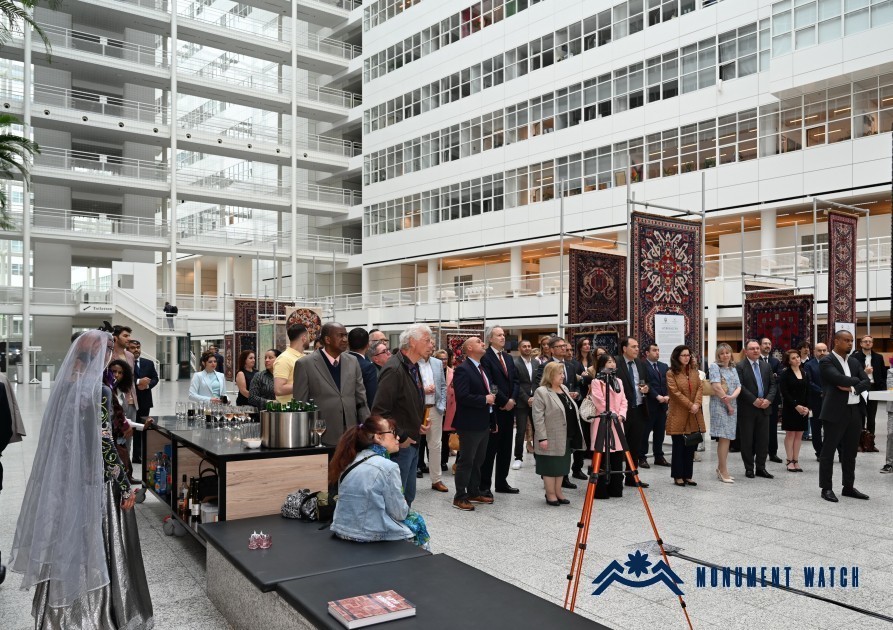
Fig. 1

Fig. 2
