The Settlement of the Lower Meghraget Valley
Location
The settlement is located in the Askeran Region of Artsakh, on the right bank of the Meghraget River, approximately 0.8 km north of the district office of “Gyughkimiya,” on a large hill. Since 2023, the site has been occupied by Azerbaijan.
Historical overview
The settlement was discovered accidentally during the collection of stone for construction purposes, as a result of which, unfortunately, a considerable part of the monument was destroyed. The results of the excavations were presented in 1991 at the Republican Archaeological Session held at the Institute of Archaeology and Ethnography (Petrosyan, Safaryan 1991, 53–54).
Archaeological investigation
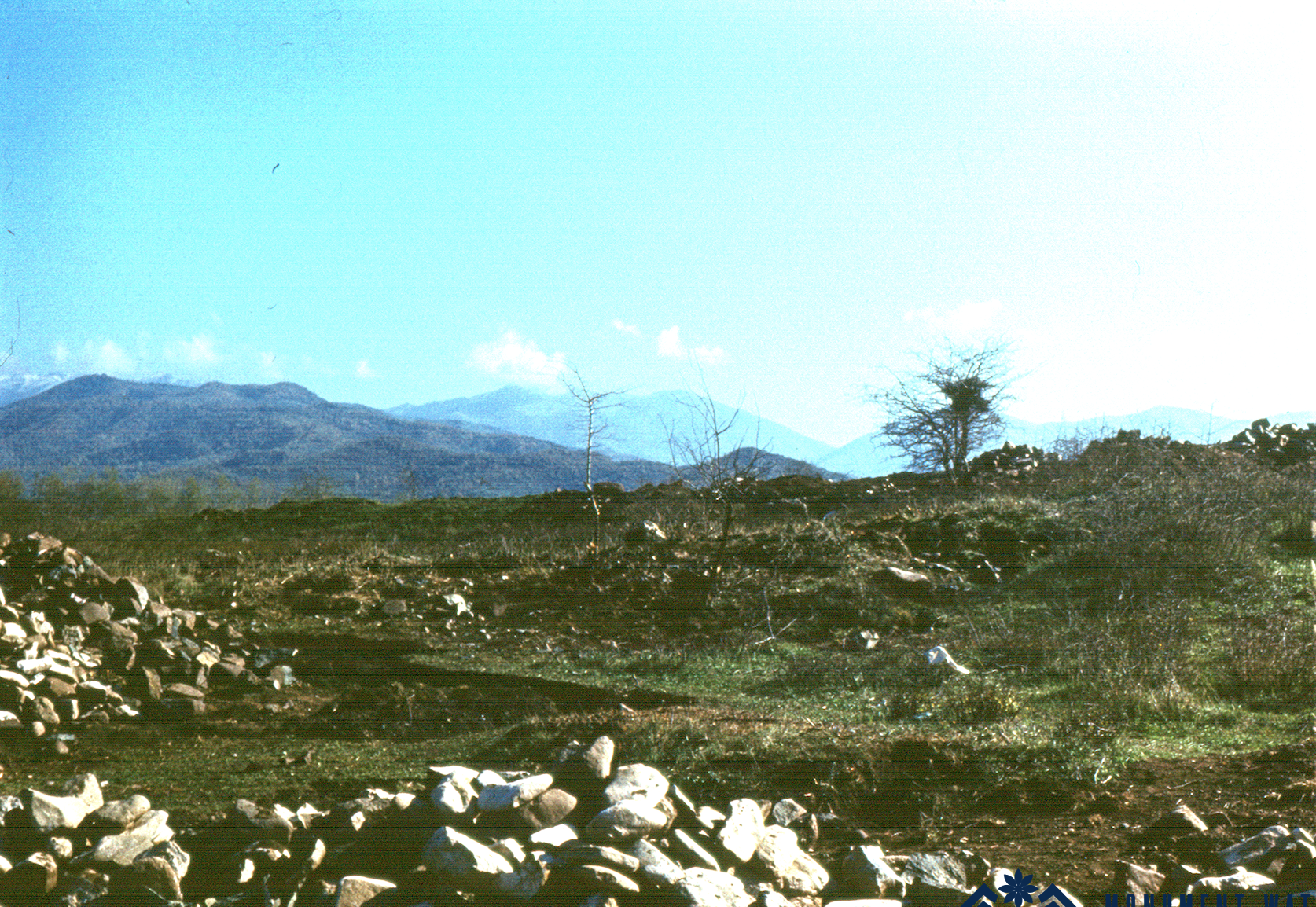
Externally, piles of stones covered with shrubs and undergrowth were visible on the northern slope of the hill (Fig. 1).
In order to clarify the stratigraphy of the settlement, exploratory excavations were undertaken on the summit of the hill, in its undisturbed section (Squares 1Z and 2Z). These revealed that this part of the hill had not been inhabited. The excavations were therefore transferred to the western edge of the disturbed area, where the remains of a clay-built platform were visible.
After cleaning, it became clear that only part of the platform had survived, measuring 0.5 × 0.36 m. It was made of unbaked clay and consisted of a complex arrangement of grooves and projections, although the surviving remains did not allow its original form to be reconstructed. Approximately 1.5 m north-east of the platform, the lower half of a large pithos was uncovered. It had a blackish-brown burnished surface and narrow bands decorated with finger impressions. It can only be suggested that these remains belonged to some type of cult complex, recalling the ritual structures known from Metsamor and Dvin.
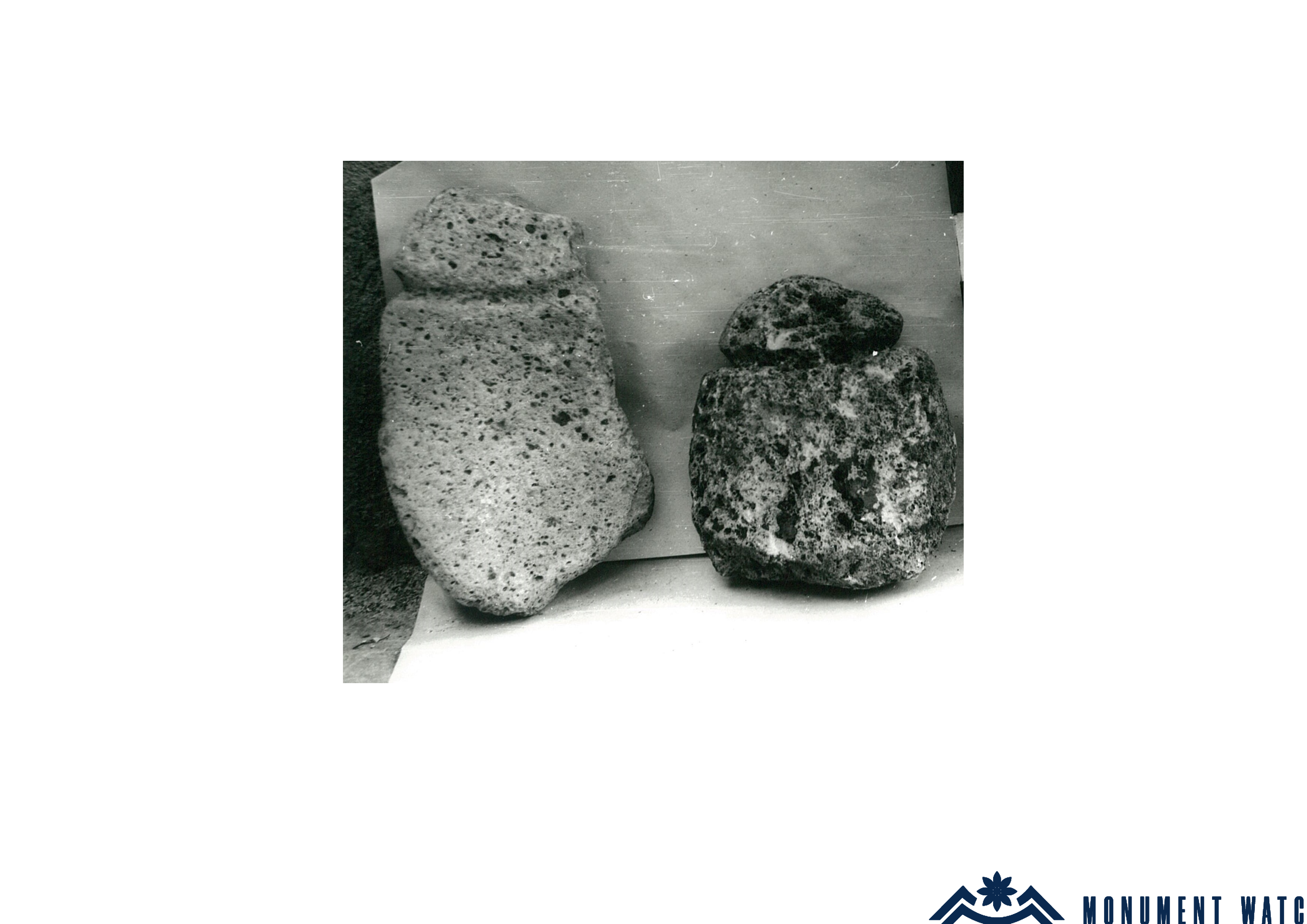
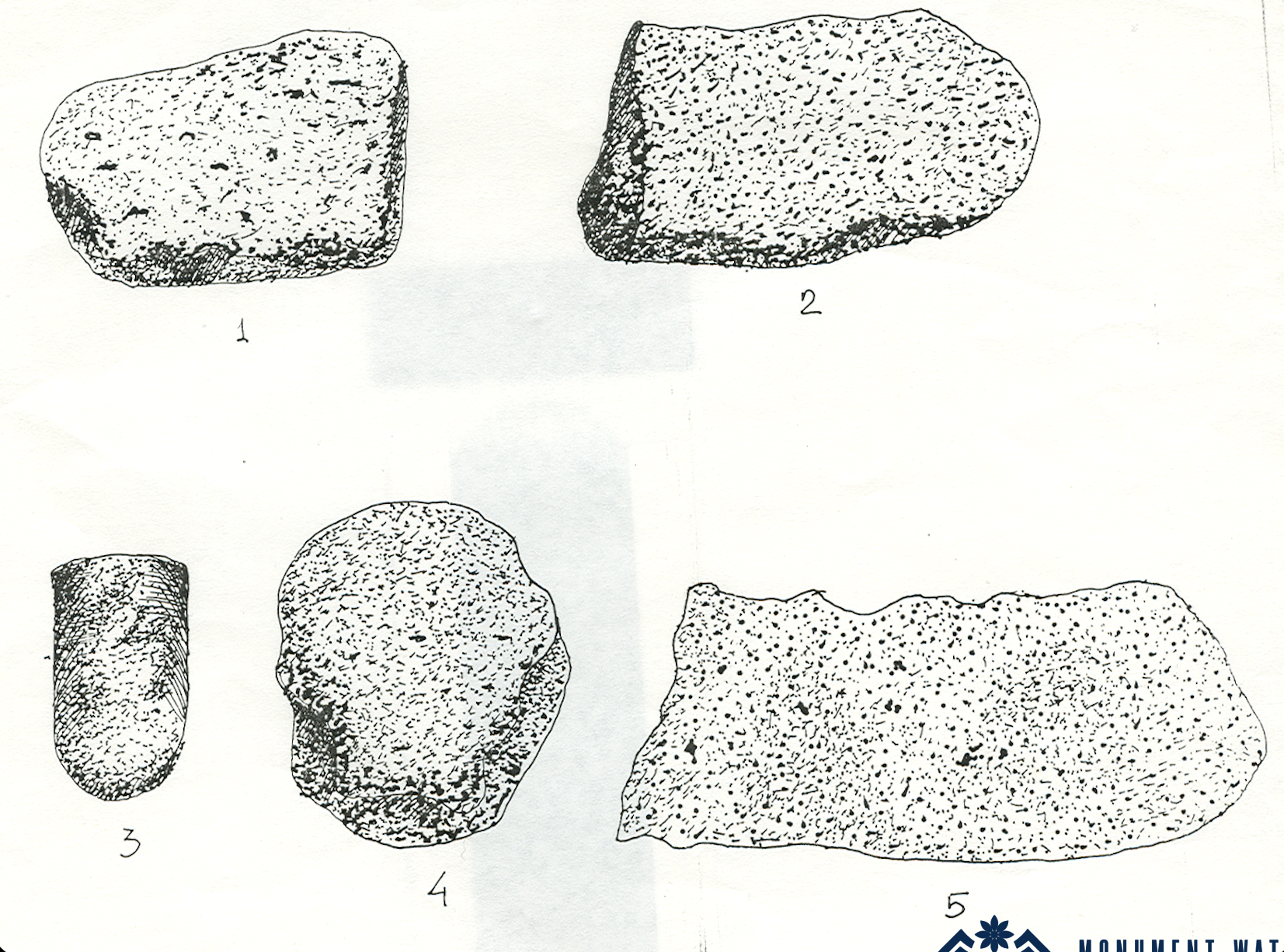
The material recovered during the excavations, together with surface finds collected at the site—including fragments of quernstones up to 0.5 m long, triangular stone stelae, fragments of blackish-brown burnished and unburnished pithoi, jugs with shaped handles, bowls with unprofiled rims, and beads made of carnelian and paste—makes it possible to date the settlement to the 9th–7th centuries BC (Figs. 2, 3).
Bibliography
- Petrosyan, Safaryan 1991 - Petrosyan H., Safaryan V., “Exploratory Excavations in Artsakh,” Republican Archaeological Session: Abstracts of Papers, Yerevan, pp. 53–54.
- Petrosyan 2006 - Petrosyan H., “Archaeological Research in Artsakh,” in The Nagorno-Karabakh Republic: Past, Present and Future, International Conference, Yerevan State University Press, pp. 425–433.
The Settlement of the Lower Meghraget Valley
Artsakh