The Uzerlik-Tepe Middle Bronze Age Settlement
Location
The site is located in the Republic of Artsakh, Askeran region, on the eastern outskirts of Akna (Aghdam), at the beginning of the Karabakh Plain, on a hill. Since 2020, it has been under Azerbaijani occupation.
Historical overview
Detailed information about the monument is preserved in the articles of the archaeologist K. Kushnareva, who excavated the settlement (Kushnareva 1957, 129-135; Kushnareva 1959, 388–430; Kushnareva 1965, 74-102; Kushnareva 1994, 118–127).
Archaeological research
In the summer of 1954, A. Yessen, head of the Oren-Kala expedition, and the expedition’s researcher, archaeologist K. Kushnareva, recorded a large concentration of obsidian and pottery fragments on the eastern edge of Akna. Among them were coarse, hand-made, black-burnished sherds, indicating the site's great antiquity. In October of the same year, small-scale preliminary archaeological work began at the settlement and continued in the spring and autumn of 1955.
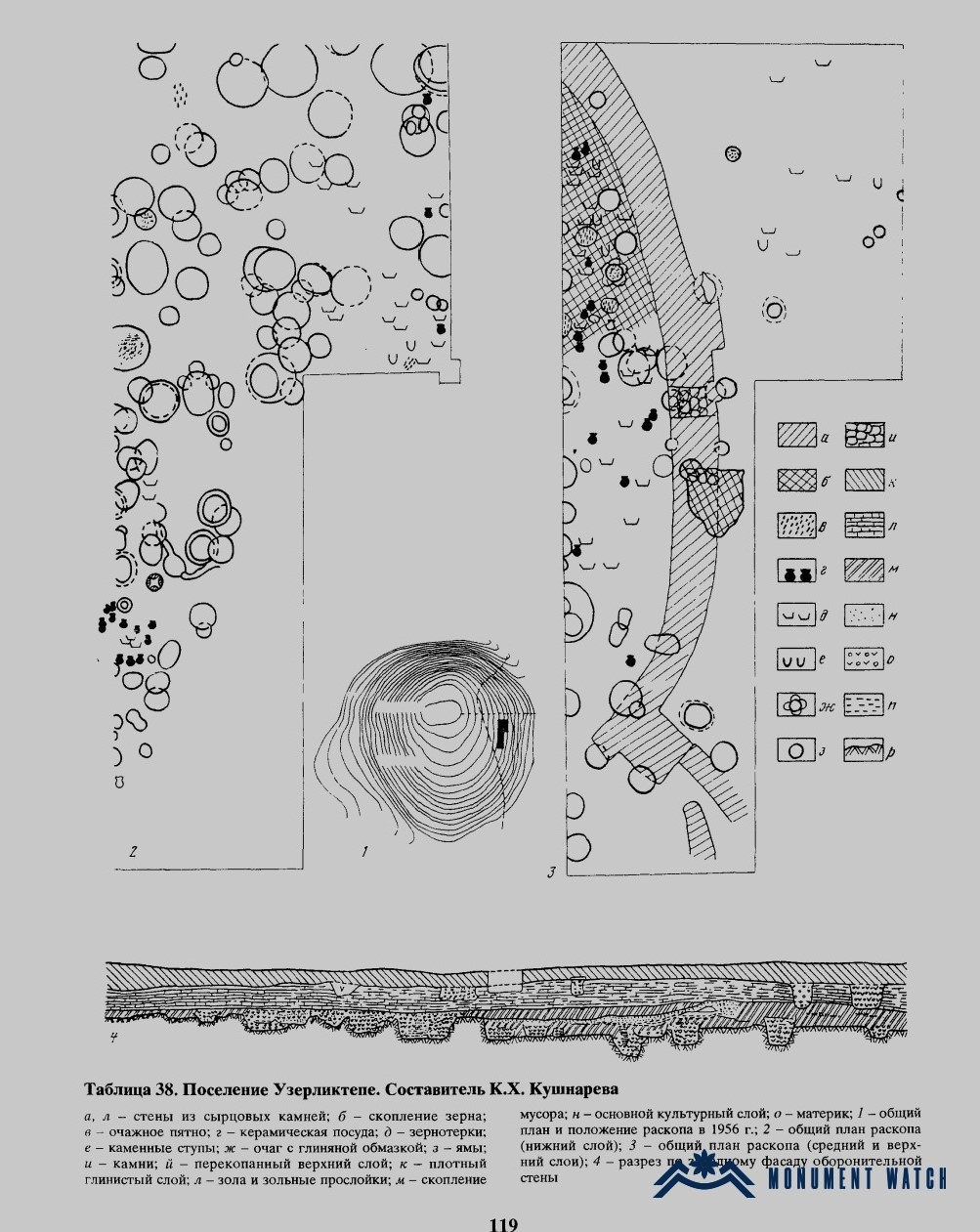
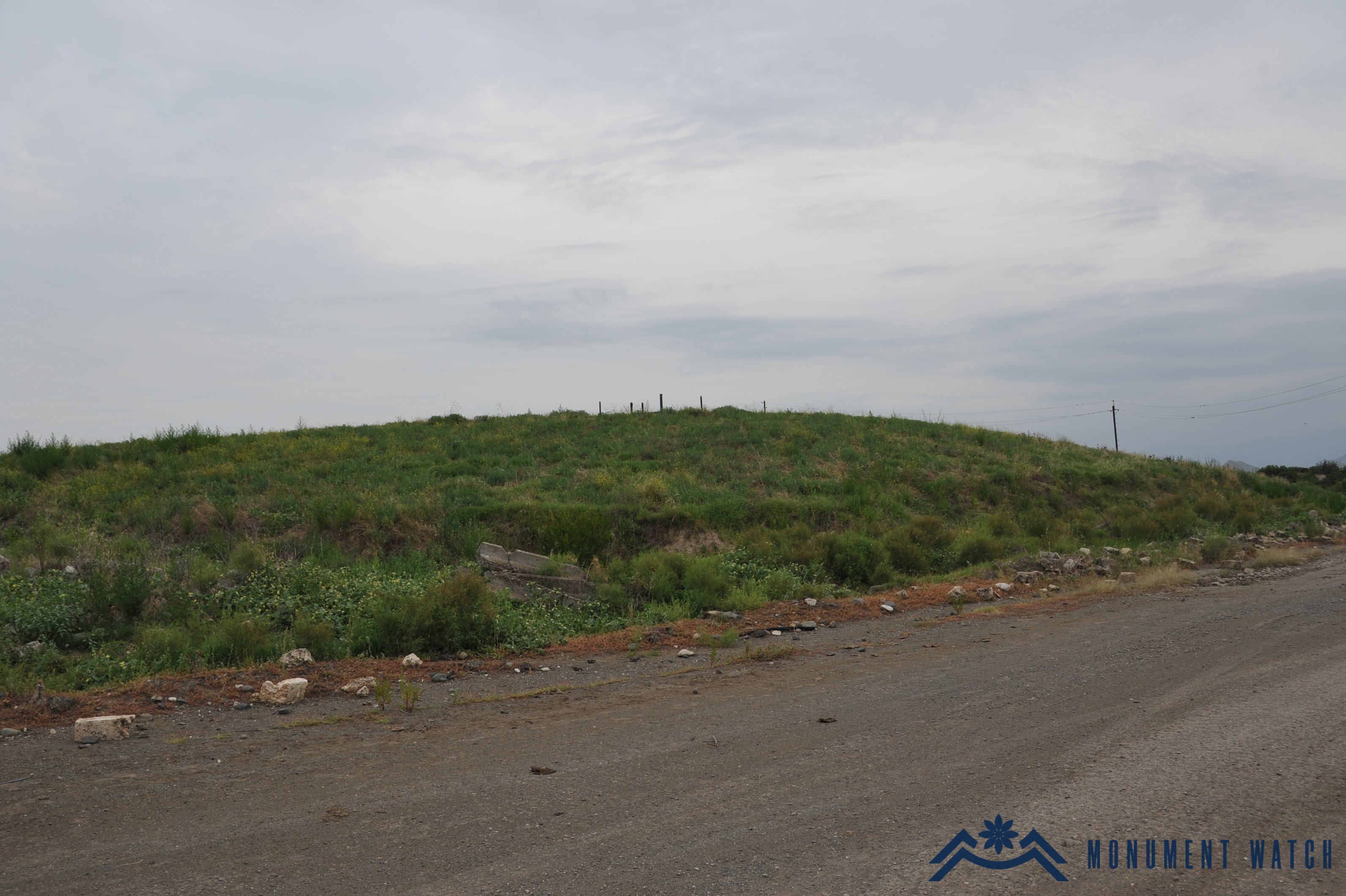
The Uzerlik-Tepe hill settlement has an irregular circular shape, with diameters of 202 and 196 meters. Its average height is 9.8 meters, and it is formed atop a natural hill approximately 3-3.5 meters high (Fig. 1).
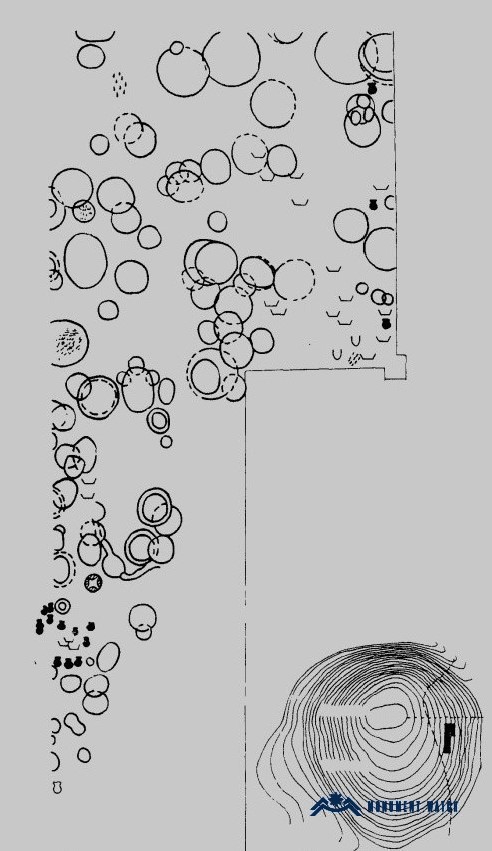
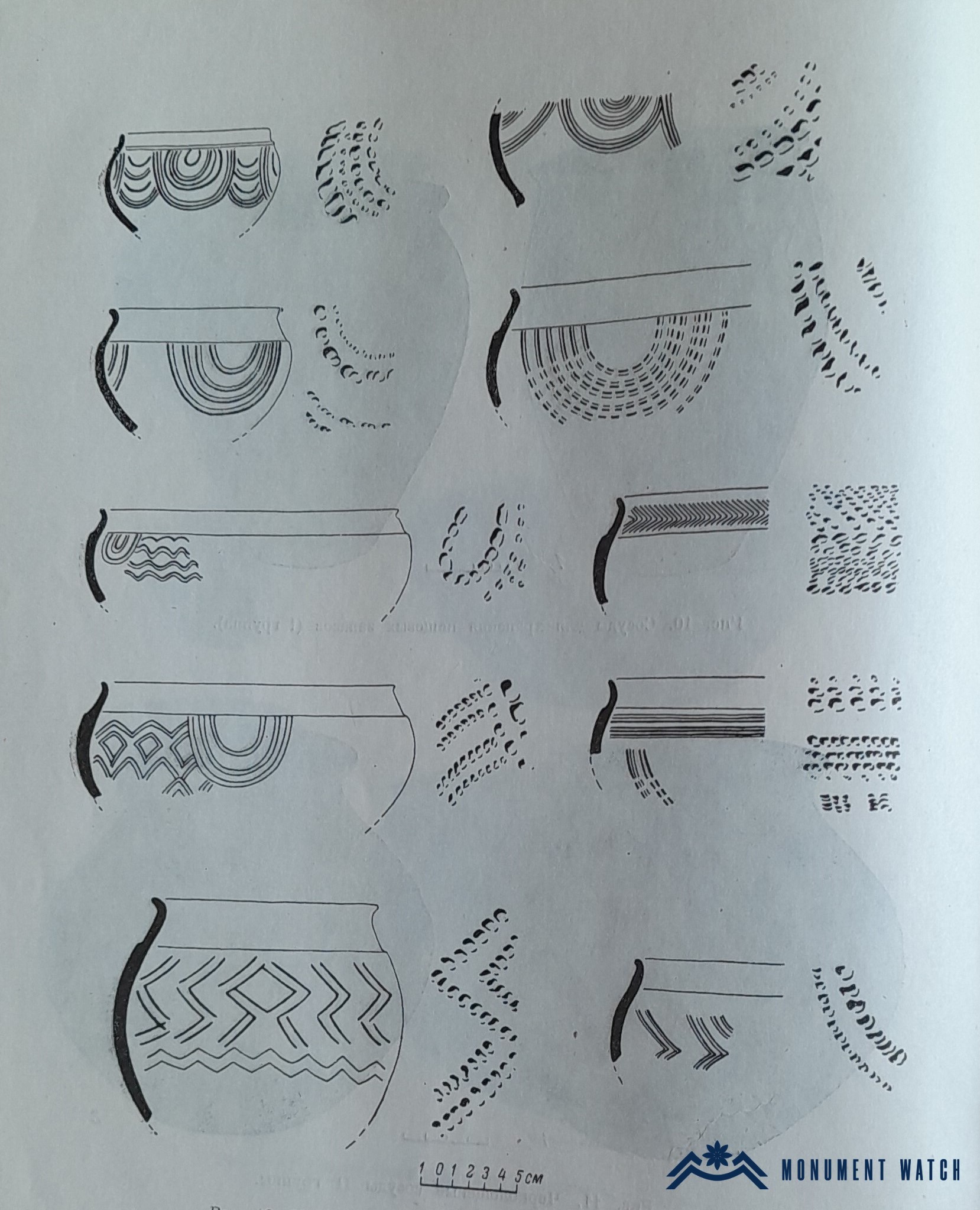
A total area of 484 m² was excavated, revealing a cultural layer up to 3 meters thick (Fig. 2). This uninterrupted three-meter cultural deposit indicates that life at the settlement persisted over a long period. The cultural layer comprises three horizons, each belonging to a different phase of the Middle Bronze Age. The division into three horizons is based on clearly established building phases. Materials recovered from these layers demonstrate the stage-by-stage development of Middle Bronze Age culture. Particularly noteworthy is the technique used to produce pottery decoration: in the lower layer, ornaments were created by incision and cutting, while in the upper two layers they were made with the so-called “walking stamp” (Fig. 3).
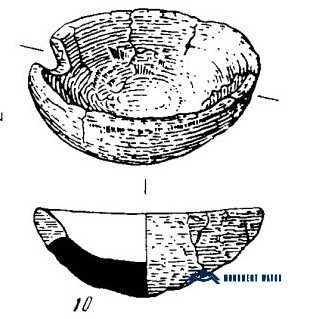
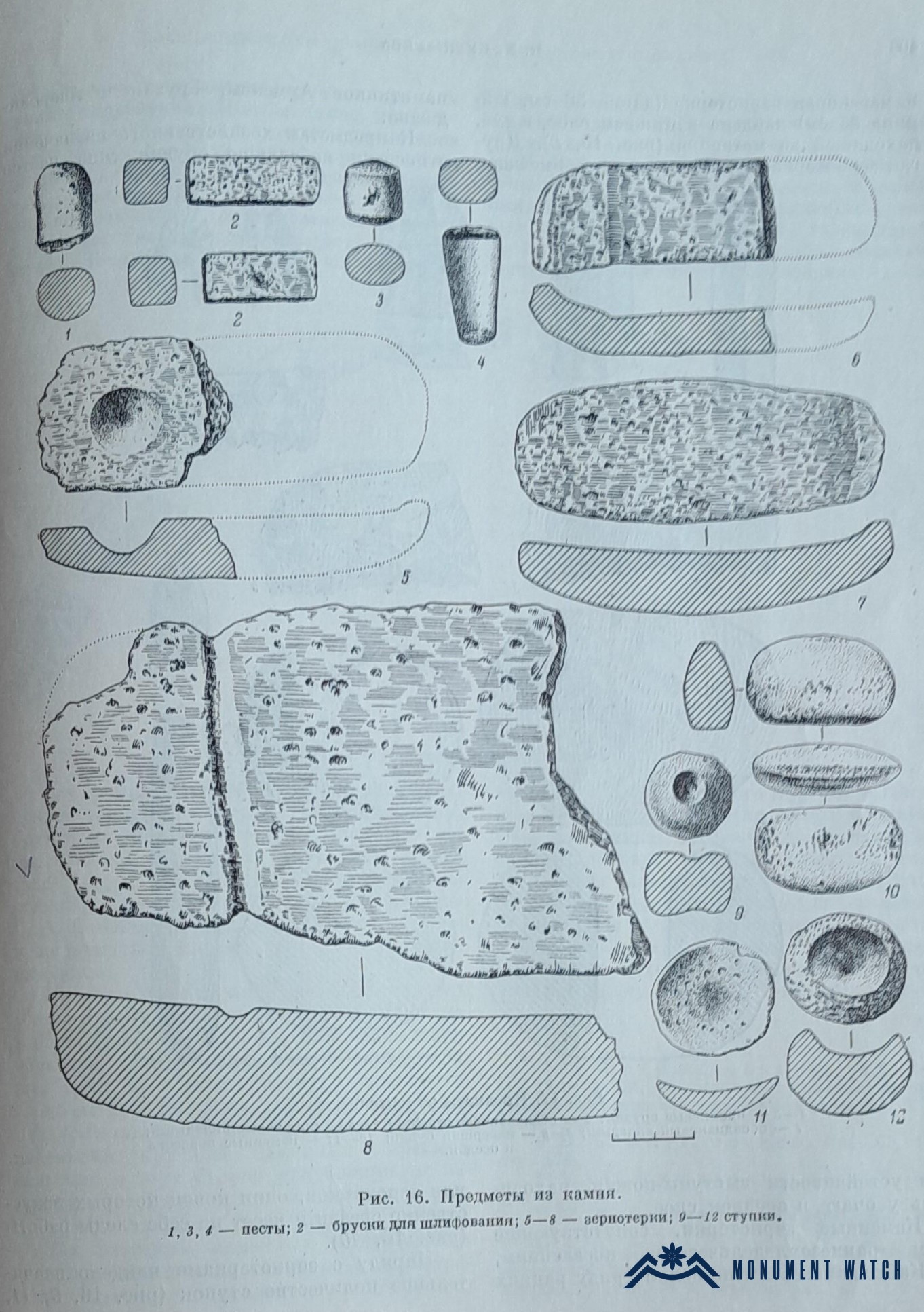
The earliest settlement (layer thickness: 0.8 m) formed on a low hill and was unfortified. It is characterised by an abundance of pits of various functions (70 pits were uncovered): ash pits near hearths, storage pits, a grain repository, and refuse pits (Fig. 4). Remains of a house built on posts were also identified in the same layer; its walls were made of reeds coated with clay. The roof consisted of wooden boards, and the clay floor was covered with matting. In the debris of the hearth, fragments of a portable clay oven were found; as ethnographic parallels suggest, bread was baked against its high vertical walls. A clay crucible was discovered in the hearth (Fig. 5), along with a piece of slag-evidence that bronze casting already played an essential role at the earliest stage of the settlement’s life. Near the hearth, river-stone pounders, polishers, and stone lids were found.
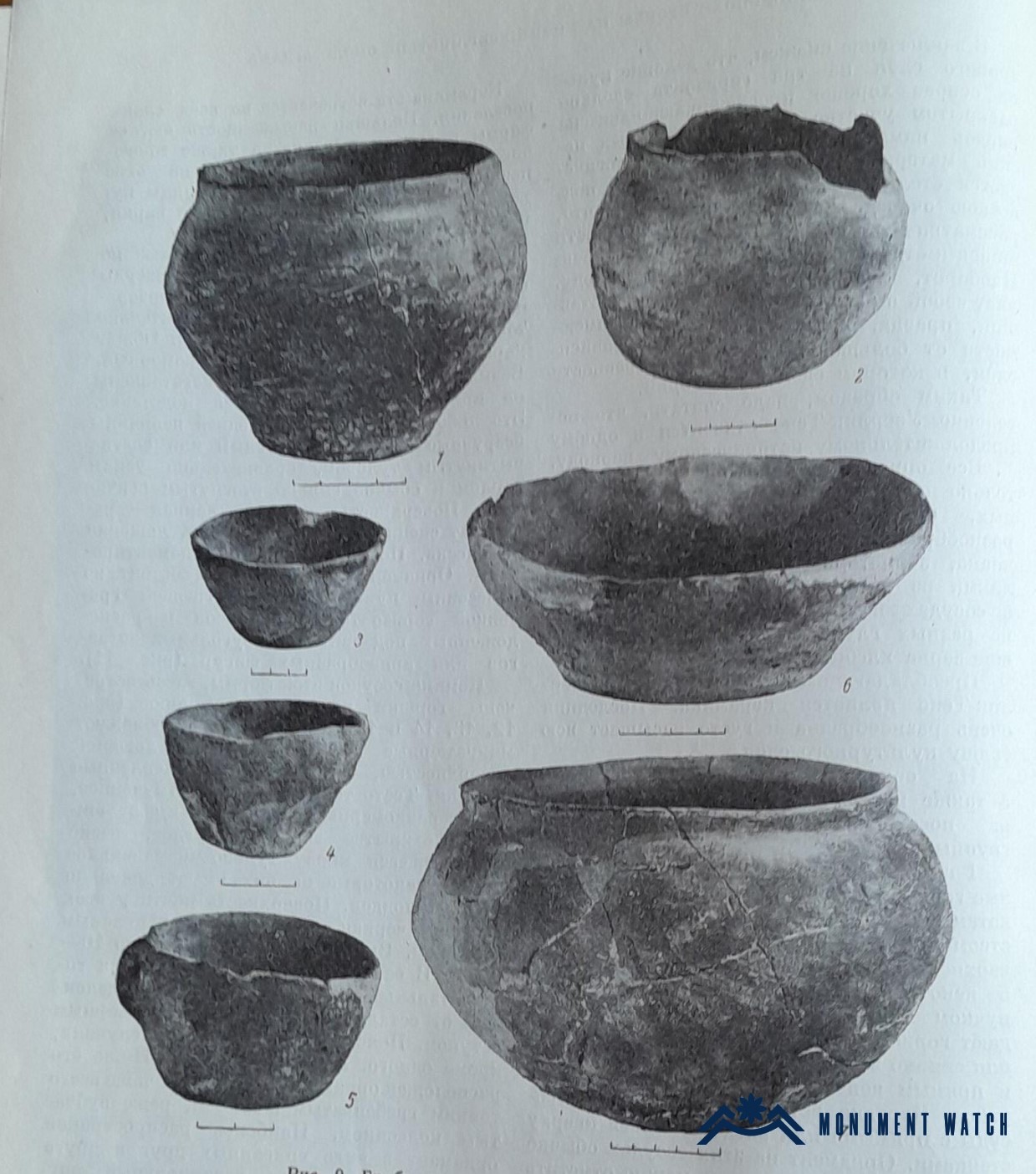
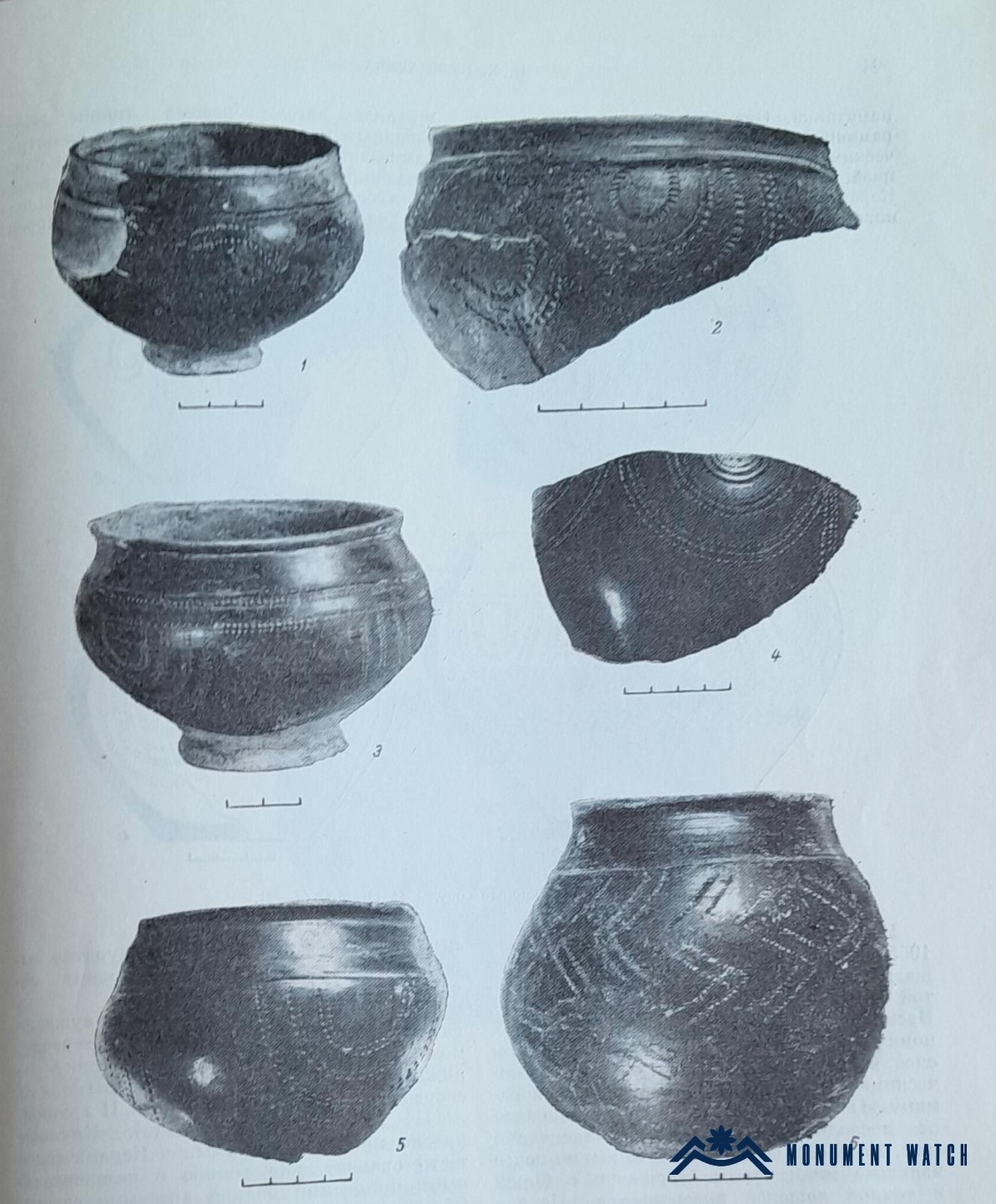
Among the finds from the earliest layer, pottery from two groups predominated. “Kitchenware” is represented by coarsely made, soot-covered, rounded and ovoid jars, pots, and small bowls (Fig. 6). “Tableware” includes small deep jars and wide-mouthed pots with rounded bodies and black or brown burnished surfaces (Fig. 7). They are decorated with incised motifs: bands or ribbons filled with short strokes or “herringbone” patterns, meanders, and arched designs.
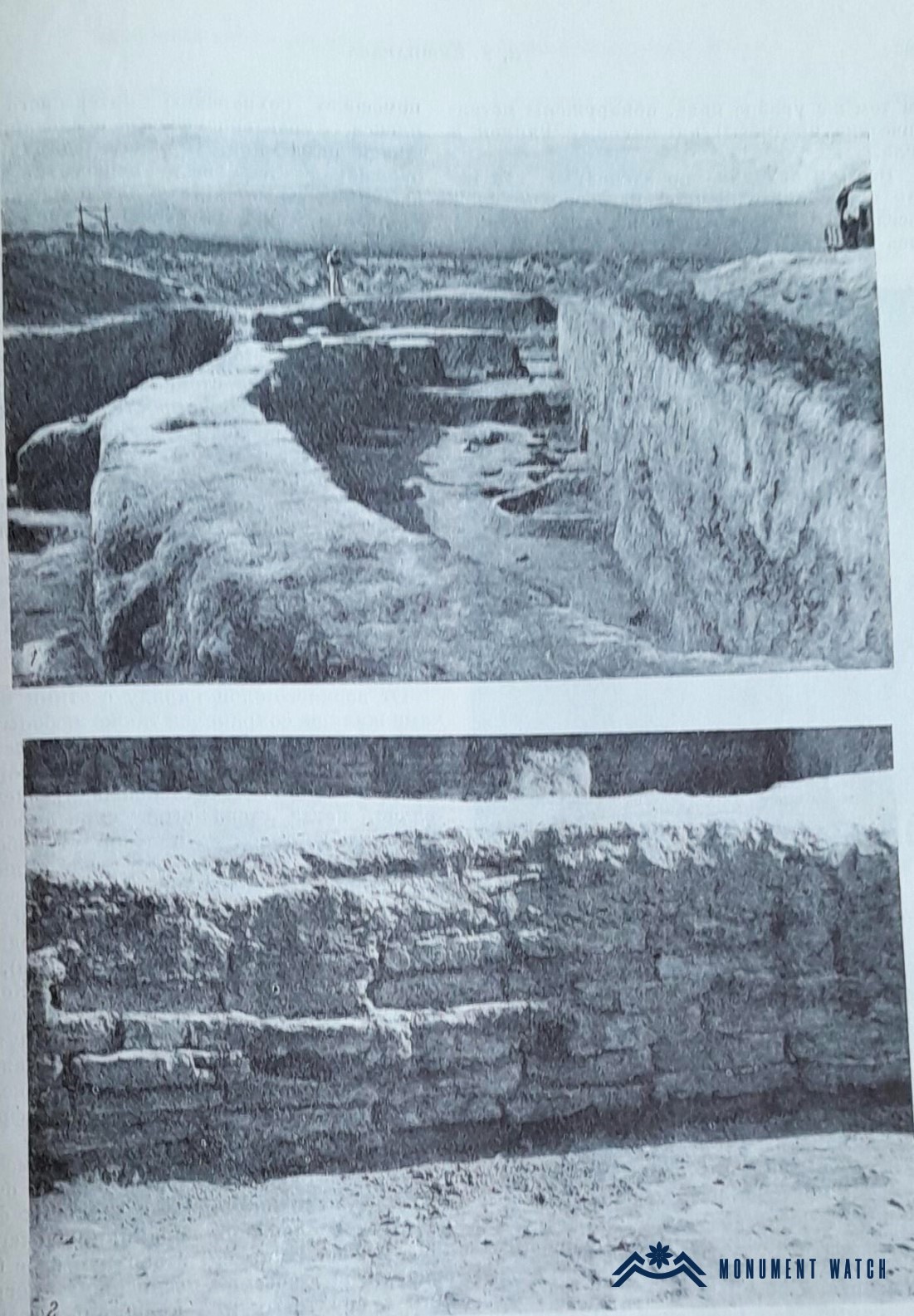
The middle layer-about 1.5 meters thick-was richer in materials. It contained a large number of stone hearths, hearth spots, and хозяйственные (economic/utility) pits. In this layer, a massive mudbrick defensive wall was uncovered. The curved outline of the cleared section (35 meters in length) indicates that the wall enclosed the central part of the hill and probably had several entrances (Fig. 8). The wall is 3 meters wide, with a preserved height of 1 meter. The principal finds and remains of dwellings were recorded on its inner side. During this period, the settlement suffered two fires, as evidenced by thick charcoal layers.
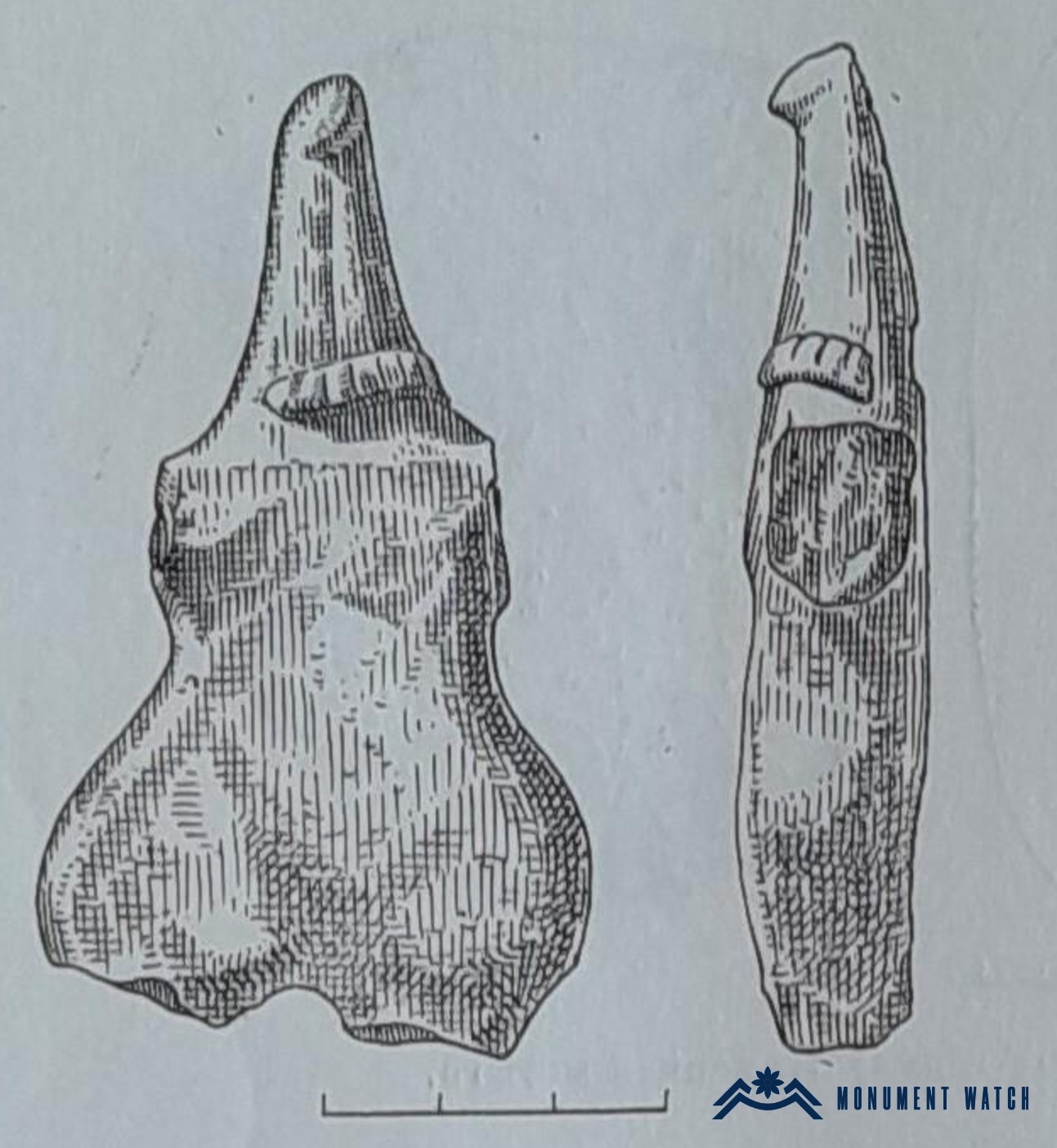
As a result of the destruction of dwellings and the accumulation of cultural deposits, the defensive wall lost its function and was leveled. Life shifted to a higher horizon, forming the upper layer that characterizes the settlement’s final stage. Despite its poor preservation, remnants of clay floors were uncovered here, with household items found on their surfaces. In the heart of one dwelling, charred grain was discovered, as well as a female figurine (Fig. 9).
Pottery from the middle and upper layers is treated as a single assemblage. The “kitchenware” did not undergo a significant change. Black-burnished pottery, however, was refined: proportionate large vessels appeared, along with elegant small vessels, sometimes equipped with a pedestal base. The quality of blackening and burnishing improved. Incised decoration was replaced by stamped ornamentation executed with a “walking comb.” The ornaments become more regularly ordered; alongside older motifs (arched designs, horizontal bands), new ones appear—interlocking ovals and vertically descending zigzag lines.
In the upper layer, ritual vessels are represented by large “hydriae.” Their painted decoration consists of vertically and obliquely arranged, hatched rhombi, including wavy variants.
Also found were sickle inserts, polishers, pounders, grinding stones, mace-heads, flint arrowheads, and bone objects (Fig. 10). The large size of the grinding stones indicates high productivity; together with the grain finds and grain-storage pits, this points to the significant role of agriculture in the local economy. Numerous obsidian fragments show that tool production was carried out at the settlement (Kushnareva 1994, pp. 118–121).
Kushnareva dates the Uzerlik-Tepe settlement to the 18th–17th centuries BCE (Kushnareva 1994, p. 127).
Bibliography
- Kushnareva 1957 - Kushnareva, K. Excavations on the Uz(er)lik-Tepe Hill near Aghdam (from the works of the Azerbaijan Expedition, 1954). Short Communications of the Institute for the History of Material Culture (KSIIMK), issue 69, pp. 129–135.
- Kushnareva 1959 - Kushnareva, K. A Bronze Age settlement on the Uz(er)lik-Tepe Hill near Aghdam. In: Proceedings of the Azerbaijan (Oren-Kala) Archaeological Expedition, vol. I (1953–1955). Materials and Investigations in Archaeology of the USSR (MIA USSR), no. 67. Moscow–Leningrad, pp. 388–430.
- Kushnareva 1965 - Kushnareva, K. New data on the Uz(er)lik-Tepe settlement near Aghdam. Materials and Investigations in Archaeology of the USSR (MIA USSR), no. 125. In: Proceedings of the Azerbaijan (Oren-Kala) Archaeological Expedition, vol. II (1956–1960). Moscow–Leningrad, pp. 74–102.
- Kushnareva 1994 - Archaeology of the USSR. The Bronze Age of the Caucasus and Central Asia. The Early and Middle Bronze Age of the Caucasus, chapter 7: “The Sevan–Uzerlik group of monuments.” Moscow, pp. 118–135.
The Uzerlik-Tepe Middle Bronze Age Settlement
Artsakh