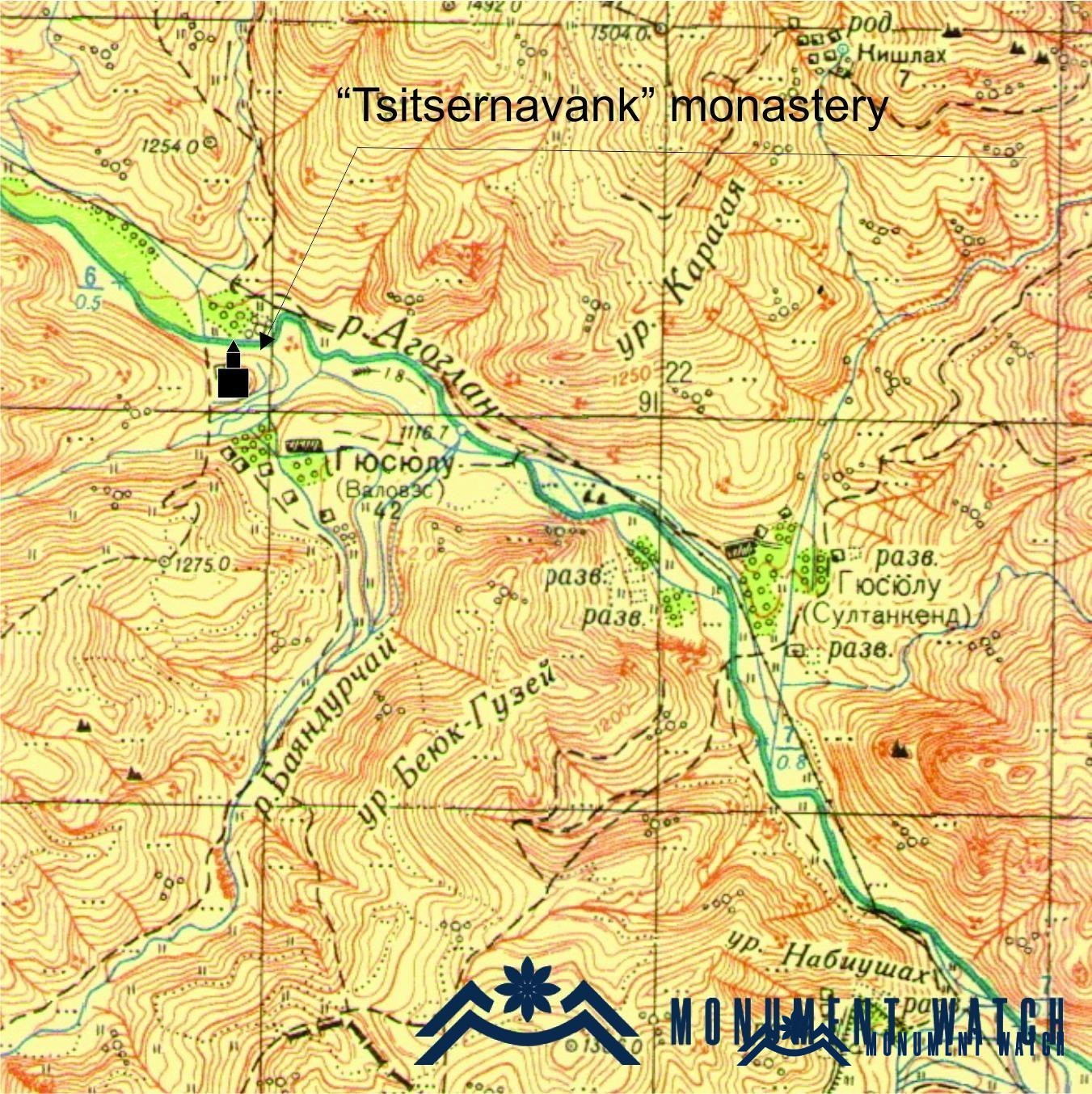
It should be noted that after the occupation of Tsitsernavank, in February 2021 a commemoration ceremony for the victims of Khojaly was held in the church, during which members of the Udi community lit candles and prayed for the souls of the Khojaly victims (https://monumentwatch.org/hy/?s=%D5%AE%D5%AB%D5%AE%D5%A5%D5%BC%D5%B6%D5%A1%D5%BE%D5%A1%D5%B6%D6%84). The same Azerbaijani side, before the liberation of Artsakh, had turned Tsitsernavank into a cowshed, completely dismantling the floor; at that time, for Azerbaijan it was not "Udi-Albanian" but Armenian—and it was being desecrated.
After the liberation of Artsakh, it became possible to carry out research and archaeological excavations at Tsitsernavank. It should also be noted that already during the expedition organized by the Academy of Sciences of the Armenian SSR in 1947, Tsitsernavank was studied alongside a number of monuments in historical Syunik (expedition head: M. Hasratyan; architect: L. Sadoyan; see Hasratyan 1980). The church was later discussed by A. Sahinyan (Sahinyan 1955, 104–105) and P. Cuneo (Cuneo 1967). The inscriptions of Tsitsernavank were studied by S. Karapetyan (Karapetyan 1999, 148–151). Incidentally, no restoration works were carried out at that time, contrary to the claim made by Natig Alishov (https://azertag.az/xeber/agoglan_monastirinda_ermeni_saxtakarligi-2484113).
The restoration works and re-consecration of Tsitsernavank were undertaken in 2001 through the philanthropy of Caroline and George Najarian and Hakob and Rudy Altiparmakian, with the support of Archbishop Mesrop Ashjian and Gurgen Melikyan.
To prepare these works, a comprehensive study of Tsitsernavank was carried out in 1997–1999: the complex was excavated and surveyed, and a restoration project for the church was drafted.
The north and south forecourts of the structure, the refectory (with a total area of 700 sq m), and the floor of the church's prayer hall were excavated. Hundreds of burials and tombstones were uncovered in the environs of the church (Simonyan, Sanamyan 2001, 203–205). Notably, while declaring the archaeological investigations "illegal," Natig Alishov attributed all of the graves—without substantiated evidence—to the Alban Christian period, whereas the majority of tombstones bear Armenian inscriptions. In front of the western entrance on the church's south façade, a rectangular inscribed basalt tombstone of Markos Parunter, set on a two-step base, was discovered (Simonyan, Sanamyan 2001, 204).
Excavations revealed the "gavit of the penitents" (apashkharoghats gavit) attached to the south façade, connecting the central and eastern entrances; in its floor, directly on bedrock, a production complex consisting of three kilns was found. In the square to the south of the church, foundation walls of separate buildings and a section of the original perimeter/retaining wall were uncovered. The archaeological finds are noteworthy: hundreds of fragments of plain and glazed ceramics (both ritual and constructional), coins, glass, iron and bronze items, rings, and more. Fragments of roof tiles were also found and served as a basis for the subsequent restoration (Simonyan, Sanamyan 2001, 203).
As had been stated earlier (Hasratyan 1980, 55) and as the most recent excavations and studies confirm, the church of Tsitsernavank underwent reconstructions in the Early Middle Ages (4th–7th centuries). The church has preserved its original appearance while undergoing partial alterations over the subsequent one and a half millennia of its use (Simonyan & Sanamyan, 2015, p. 171) (Fig. 3).
The basilica of Tsitsernavank is "Albanized" based on the claim that one pair of piers stands opposite one of the entrances—supposedly a configuration not found in "the Christian architecture of Armenia and Georgia" (Akhundov 1986, 224). Already in 1980, M. Hasratyan, commenting on this "misunderstanding," wrote that the author, unaware of the reconstruction of the piers at Tsitsernavank, makes such unfounded generalizations (Hasratyan 1980, 14). The position of the piers relative to the entrances arose when the church's original wooden roof was replaced by a stone vault (the piers having been "reinforced"). For the same reason, piers are likewise located opposite entrances in other Early Medieval Armenian basilicas—Yereruyk, Yeghvard, and Tekor (Kirakosyan 2024).
The three pairs of piers bearing the stone vault were replaced with four pairs of wider, square-plan piers. At the same time, the wall-piers were widened. The increased number of supports reduced the radius of the arches. It lowered their springing level, which made it possible—without additional works—to set the new vault under the west pediment without disturbing the exterior volumetric–spatial solution. The currently extant southern colonnade and the preserved section of the central nave vault are the result of that reconstruction. Incidentally, the construction inscription of the reconstruction, which was placed above the south entrance, was torn out of the masonry by the Azerbaijani side and had disappeared by 1989–1992. Meanwhile, Azerbaijan's "State Committee on Work with Religious Organizations" attributes this disappearance to the Armenian side (https://scara.gov.az/az/xeberler/print/agoglan-mebedi-v-vi-esrler-kosalar-kendi).
Research conducted already in the Soviet period, and subsequently the 1999–2001 archaeological excavations and studies, have confirmed that at the end of the 18th century (1779, as indicated in the reconstruction inscription), certain repairs were carried out at Tsitsernavank. To this period belongs the six-column belfry with a conical spire built on the western edge of the altar roof. At the same time, the bema was rebuilt and raised—changes which Azerbaijani authors characterize as unlawful, modern alterations introduced by Armenians into Tsitsernavank's interior.
The restoration of the monument ensemble was implemented based on a comprehensive examination and correlation of field research, measured drawings, and archival materials. (This integrated program was carried out by the expedition of the Editorial Board of the "Corpus of Armenian Monuments" of the Administration for the Protection of Historical and Cultural Monuments of the Republic of Armenia. Project and excavations head: Hakob Simonyan; 1999–2001 measurement and restoration project, head of the architectural group: Hovh. Sanamyan, head of restoration construction works: Georgi Arakelyan; archaeologists: Artyom Harutyunyan, Vahagn Hovhannisyan; architects: Gor Mikaelyan, Grigor Nalbandyan, Andranik Sargsyan, Armen Topraghaltsyan, Mesrop Hovhannisyan, Lusine Nikoghosyan, Anna Gasparyan; art historians: Samvel Hovhannisyan, Tigran Simonyan; materials specialists: Vahagn Israelyan, Rafael Matevosyan; geologist: Gagik Khachatryan; structural engineer: Karlen Karamyan; anthropologist: Ruzan Mkrtchyan; and others. The total number of specialists involved in the comprehensive study of the monument, over different years, amounted to twenty.)