Azerbaijan Presents the Distortion of Armenian Heritage to the International Community as a Lawful Practice
On 2 May, representatives of the diplomatic corps accredited in Azerbaijan—more than 150 ambassadors, diplomats, military attachés, and other officials from 62 countries and international organizations—visited various Armenian cultural sites and museums in Artsakh, thereby witnessing the ongoing processes through which these sites are being Azerbaijanized (Figs. 1, 2) (https://ru.irevanaz.com/index.php?newsid=11788).
In particular, the delegates, accompanied by Hikmet Hajiyev, Head of the Foreign Policy Affairs Department of the Presidential Administration of Azerbaijan, visited the 19th-century Armenian Church of Surb Amenaprkich Ghazanchetsots in Shushi. Following Azerbaijan’s deliberate double bombardment of the church on 8 October 2020, during the days of the war, the monument has been deformed and distorted under the guise of “restoration,” in violation of international norms for the preservation of cultural property—particularly the principles of authenticity and integrity established by UNESCO (Fig. 3).
The well-known Azerbaijani news outlet Report.az stated that the diplomats were introduced to the historical and cultural monument, as well as to Azerbaijan’s efforts to preserve multi-religious heritage. In reality, however, this is not multi-religiosity, but the destruction of Armenian identity, the removal of Armenian traces from the region, and the denial of Armenian existence.
On the same day, Hikmet Hajiyev posted a video from the Ghazanchetsots Church in Shushi on social media. In the post, he stated in particular that “the church has been restored in accordance with its original architectural style. All lawful structures located on the territory of the Republic of Azerbaijan, as well as historical, cultural, and religious monuments, are preserved, placed under state protection, and restored in accordance with national legislation” (https://x.com/hikmethajiyev/status/2050464536839553354?s=46&fbclid=IwY2xjawRkJxBleHRuA2FlbQIxMABicmlkETFBOVdET2VPRG1IdEQ4VU5hc3J0YwZhcHBfaWQQMjIyMDM5MTc4ODIwMDg5MgABHiLIyCopLKsjus39OqTJAIYRX0MukKuiE9Yo4G13d6020-nYqtjbxsedFF7w_aem_DcpPPIIi4fb9ZA_83o7a6Q).
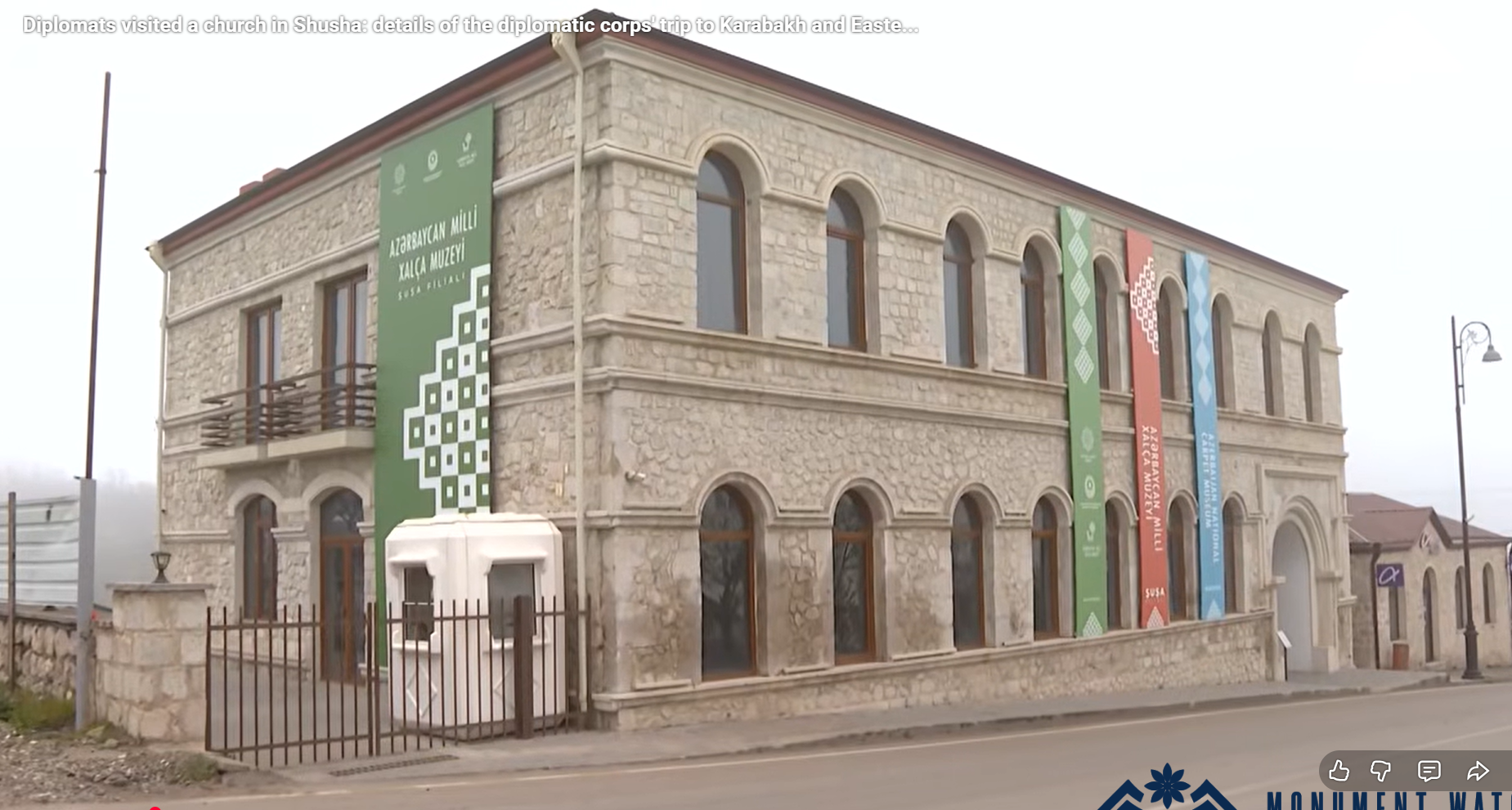
Particular attention was also given to the Shushi branch of the Carpet Museum (Fig. 4), where Azerbaijani carpets were presented to the diplomats in a space emptied of historical Armenian carpets from Artsakh. Armenian Artsvagorg and Vishapagorg carpets were likewise presented under an Azerbaijani label (https://www.youtube.com/watch?v=_m1vnftvmZ4). The video shows carpets with Artsakh ornamentation and typology being presented as Azerbaijani heritage.
In Shushi, the delegation was also introduced to the project for a new mosque at the “Yeni Shusha” (“New Shushi”) Mosque, whose foundation was laid in 2021 (https://www.youtube.com/watch?v=XnDkhFmBeSU). As is known, this constitutes a separate direction of Azerbaijan’s cultural policy, whereby mosques are built in Armenian territories, on the sites of destroyed cultural monuments, and the formerly Christian Armenian landscape is Islamized.
Within the framework of the visit, the representatives of the diplomatic corps were also introduced to the reconstruction works in Shushi and Lachin—in reality, works of Azerbaijanization—including new infrastructure, recreation centers, and the “Zerti” agro-industrial park, where activities in various sectors of the economy were presented. At the same time, the interest and readiness of several countries to participate in regional development projects were noted (https://www.youtube.com/watch?v=_m1vnftvmZ4), and the directions of Lachin’s development and new projects were also presented (https://www.youtube.com/watch?v=XnDkhFmBeSU).
Our response
After the war, Azerbaijan announced that Surb Amenaprkich Ghazanchetsots Church in Shushi would be returned to its “historical appearance,” which should have implied the removal of the traces of the double bombardment and the restoration of the dome. Yet what we witnessed was that the Azerbaijani side dismantled the cross-shaped window on one of the gabled façades and the relief sculpture above it. The sculpture on the western façade represented the theme of “Christ Bearing the Cross”, accompanied by an inscription, which has likewise been erased. From the very beginning of the construction works, it was clear that their purpose was to destroy the details, elements, inscriptions, and other features that conveyed the cultural significance of the cathedral.
Numerous facts demonstrate that the illegal and false “restorations” of Surb Amenaprkich Ghazanchetsots Church in Shushi aim to alienate it from Armenian culture. First, historical evidence shows that the church was built by a special commission: the order was given by the city’s spiritual and faithful community, who wished the church to be constructed after the model of the medieval Cathedral of Ani. However, the plan of the church prepared by the city inspector resembled, in its architectural composition, the Mother Cathedral of Etchmiadzin. The inscription placed above the southern portal of the church states that the cathedral was built through donations from the parishioners of Shushi; construction began in 1868 and was completed in 1887. The names of the architect-builder Simeon Ter-Hakobyants and master Avetis Yaramishyants were also preserved on the wall of the bema front of the church (https://monumentwatch.org/hy/monument/շուշիի-սբ․-ամենափրկիչ-ղազանչեցոց-եկե).
Through the Azerbaijani “restoration,” the dome of Surb Amenaprkich has been transformed into a hemispherical volume. Armenian dome architecture does not attest even a single example of a church with such a dome. The domes of Armenian churches have conical and pyramidal roofs. The pointed gables at the upper part of the drum of Ghazanchetsots themselves demonstrate that it was designed for a roof with corresponding edge volumes. In other words, the fan-shaped cornice preserved at the upper part of the drum after the Azerbaijani “restoration” demands only a pyramidal superstructure.
As a result of the Azerbaijani restoration, the drum has acquired an absurd appearance, inappropriate for any ecclesiastical structure. As early as the 19th-century archival photographs, the church was crowned with a fan-shaped roof (https://www.academia.edu/110556759/Holy_All_Savior_Ghazanchetsots_Church_in_Shushi_and_Protection_of_Cultural_Heritage_in_Azerbaijan; https://doi.org/10.54338/27382656-2022.3-005), which evidently caused serious concern for official Baku. To restore the roof would have meant acknowledging and displaying the Armenian architectural dominance of Shushi.
Through the illegal restorations of Surb Amenaprkich Church in Shushi, Azerbaijan violates the principle of authenticity established by UNESCO’s 1994 Nara Document on Authenticity, according to which conservation comprises the range of processes aimed at understanding cultural heritage, recognizing its history and significance, promoting heritage, and ensuring its restoration and consolidation. In this case, people’s ability to understand heritage depends, among other things, on reliable and truthful knowledge about that heritage; knowledge and proper understanding of information sources are necessary prerequisites for assessing all aspects of authenticity and credibility (UNESCO, Nara Document on Authenticity, Article 9, “Values and Authenticity”).
With regard to the destruction of historical evidence, it should be noted that, according to the criterion of cultural significance, preserving the historical value of heritage means preserving the historical evidence of that value (Burra Charter, Article 2.3). Moreover, any intervention in heritage that results in the loss of one or another element of cultural significance—historical, aesthetic, spiritual, or social—deprives that heritage of its fundamental meaning and thereby destroys it (Burra Charter, 2013, p. 14).
For more detailed information on Azerbaijan’s false restorations, see also the following links: The Illegal Restorations of Surb Ghazanchetsots Church in Shushi, 15 May 2021, https://monumentwatch.org/en/alerts/illegal-reconstruction-of-the-surb-ghazanchetsots-church-in-shushi/, https://monumentwatch.org/en/alerts/about-the-azerbaijani-restoration-of-surb-amenaprkich-ghazanchetsots-church-in-shushi/ .
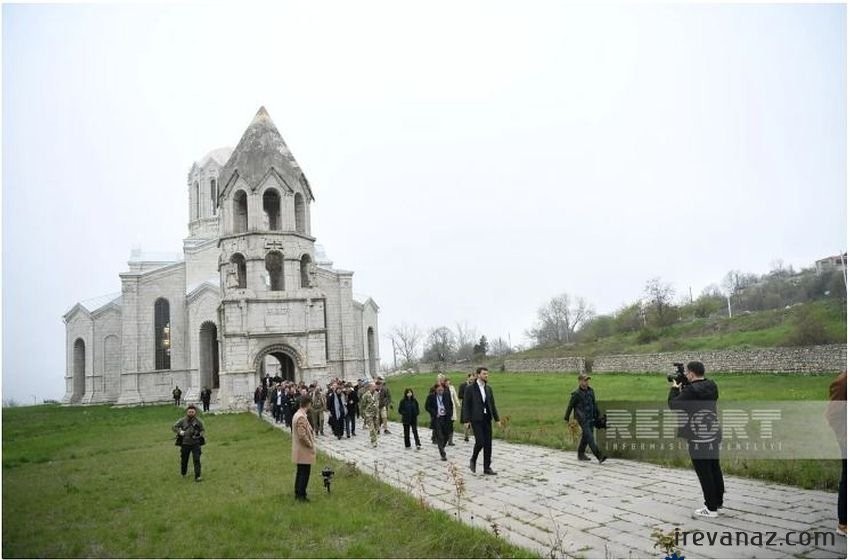
Fig. 1. The visit of representatives of the diplomatic corps accredited in Azerbaijan to Surb Amenaprkich Ghazanchetsots Church in Shushi.
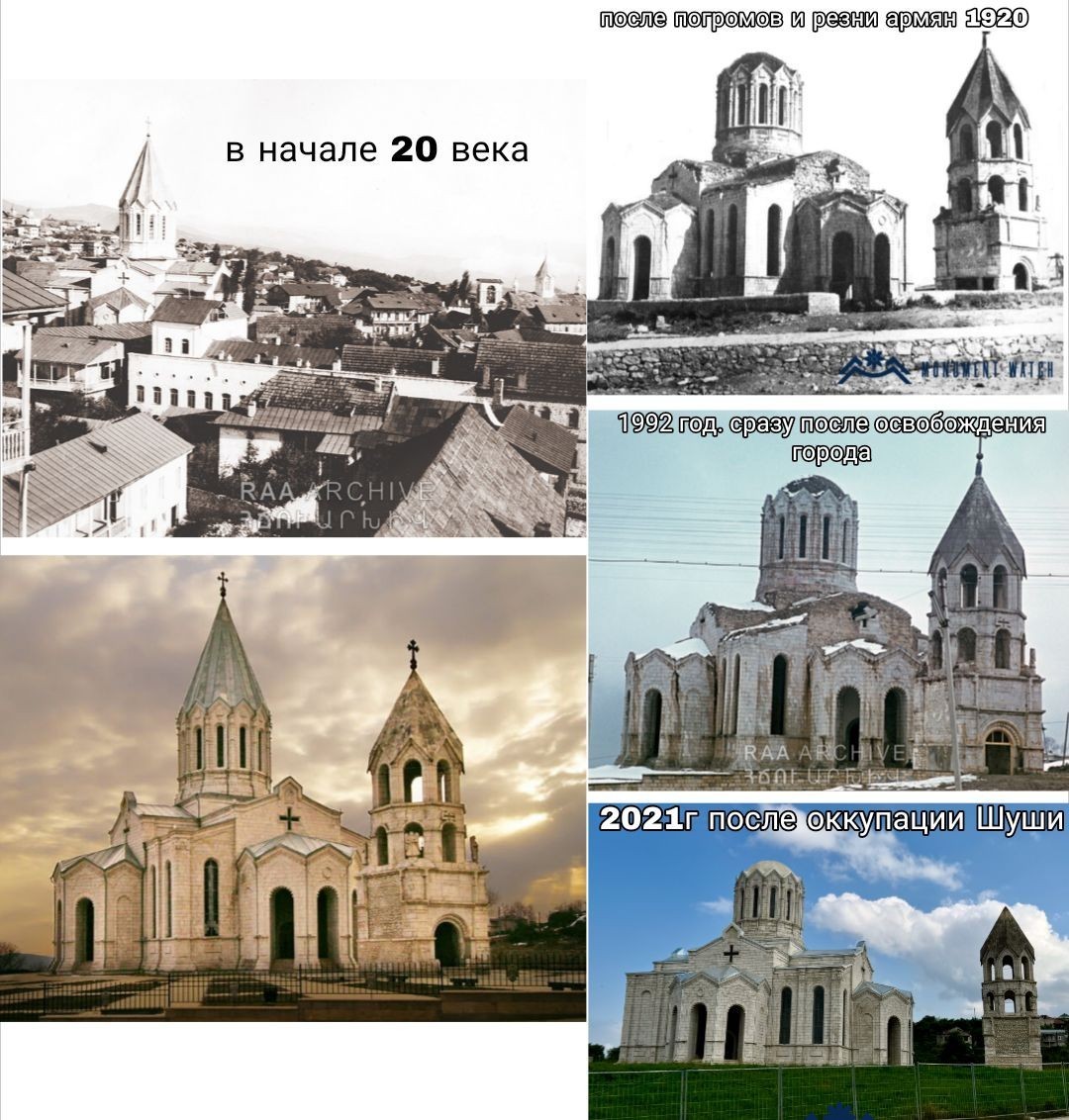
Fig. 3. The authentic and distorted appearances of Surb Amenaprkich Ghazanchetsots Church in Shushi. Photo: from Alen Ghulyan’s page.
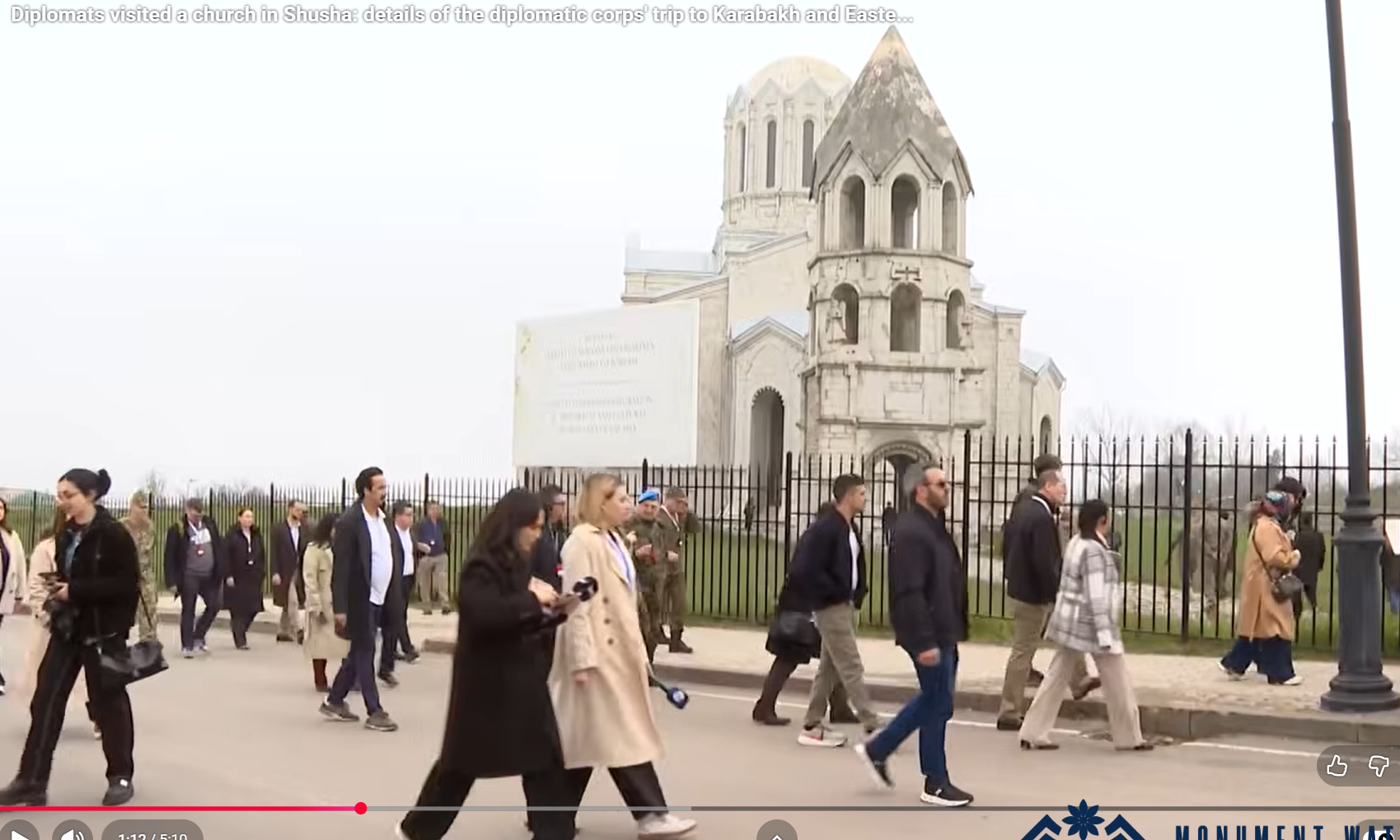
Fig. 2. The visit of representatives of the diplomatic corps accredited in Azerbaijan to Surb Amenaprkich Ghazanchetsots Church in Shushi.