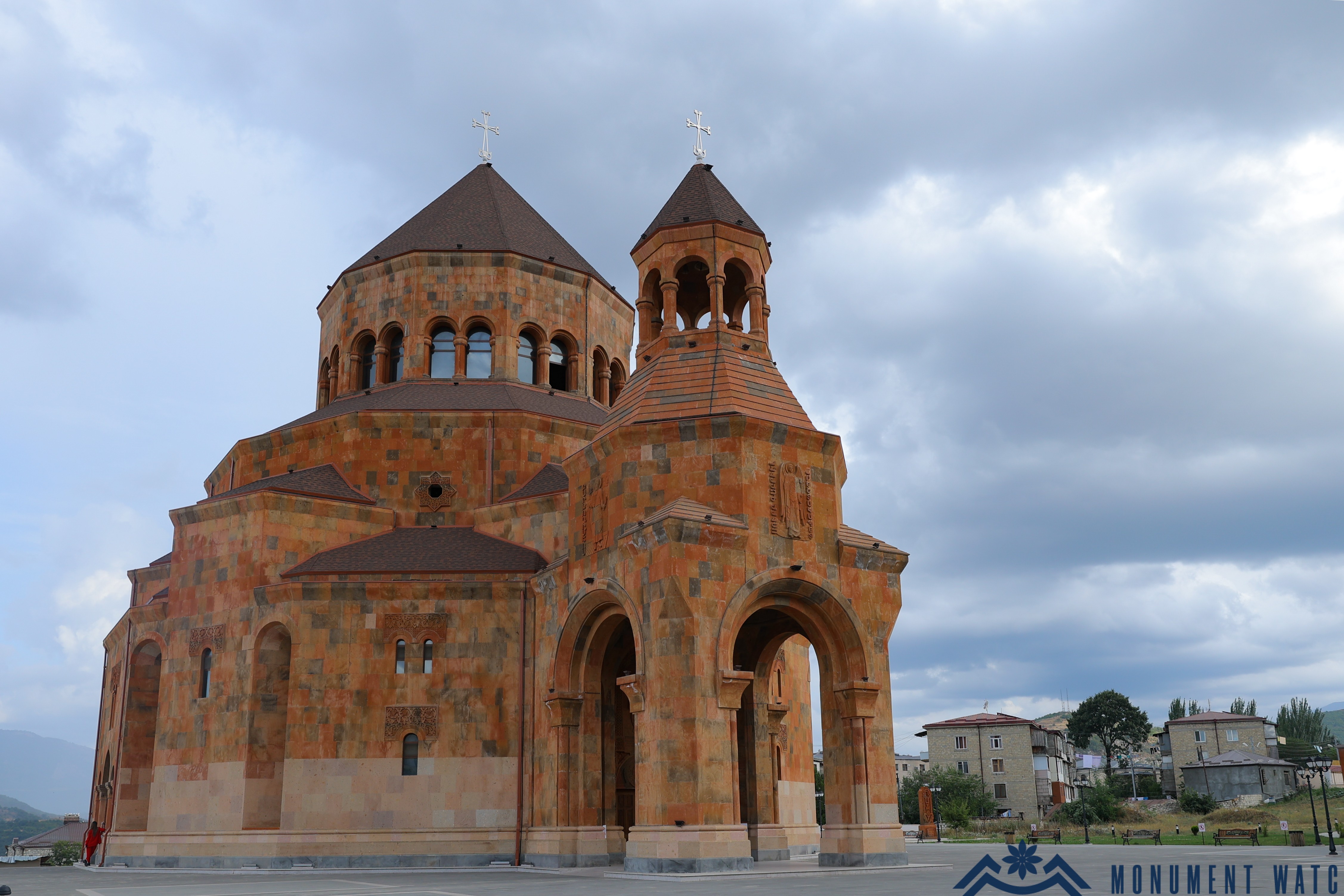
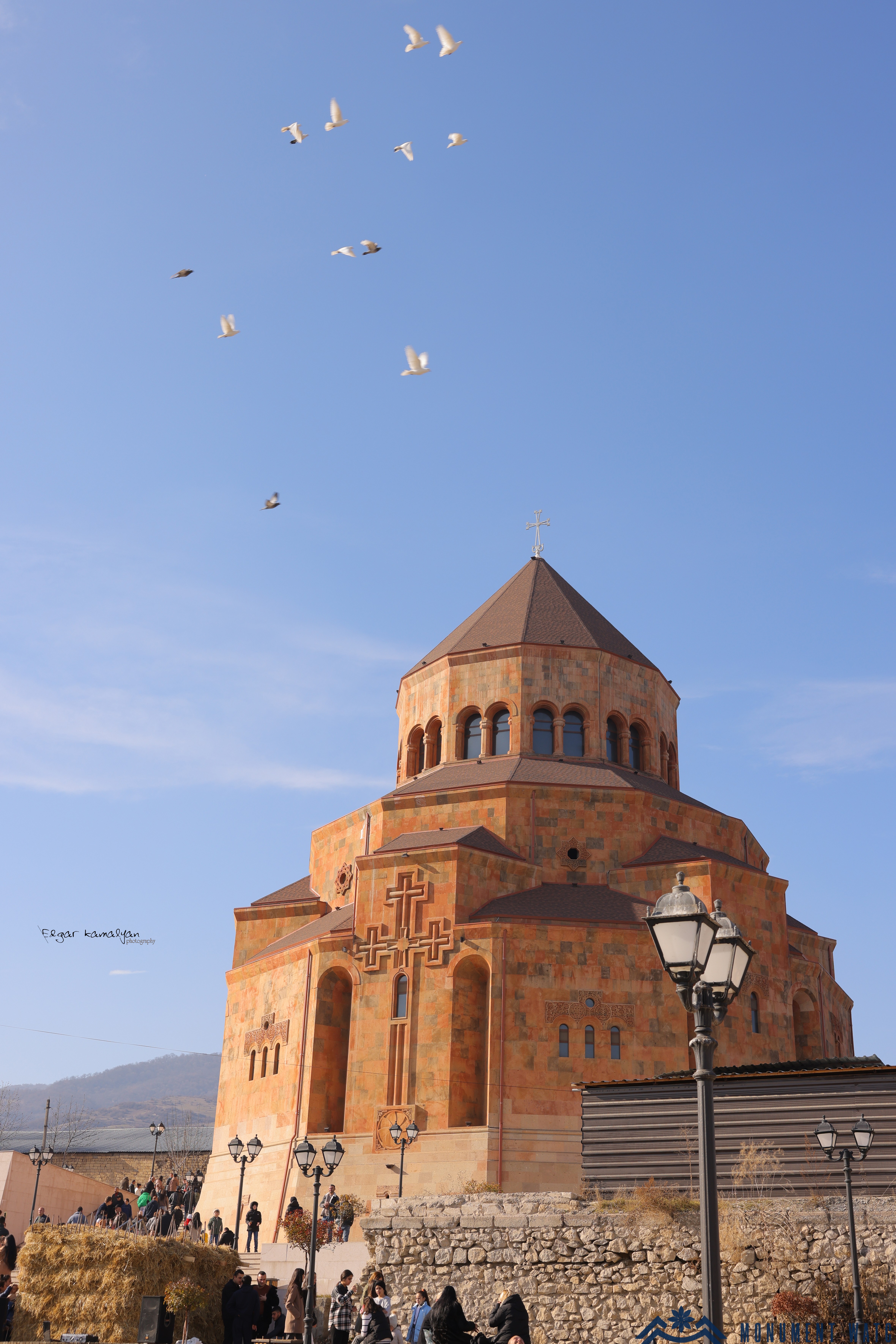
On 21 April 2026, it became known that the Cathedral of the Protection of the Holy Mother of God in Stepanakert had been completely destroyed. One of the most important spiritual and architectural symbols of Artsakh, the cathedral was located in the central, elevated part of Stepanakert, the capital of the Republic of Artsakh, in the upper section of Nelson Stepanyan Street (Fig. 1). Its exterior appearance and ground plan combined elements of the Zvartnots and Hripsime cathedrals (Figs. 1, 2).
It should be emphasized that cases of damage and vandalism affecting the cathedral had already been recorded by the Monitoring the Cultural Heritage of Artsakh team in early April of this year, when it was documented that two of the cathedral’s windows had been broken (https://monumentwatch.org/hy/alerts/արցախում-շարունակվում-է-մշակութային/).
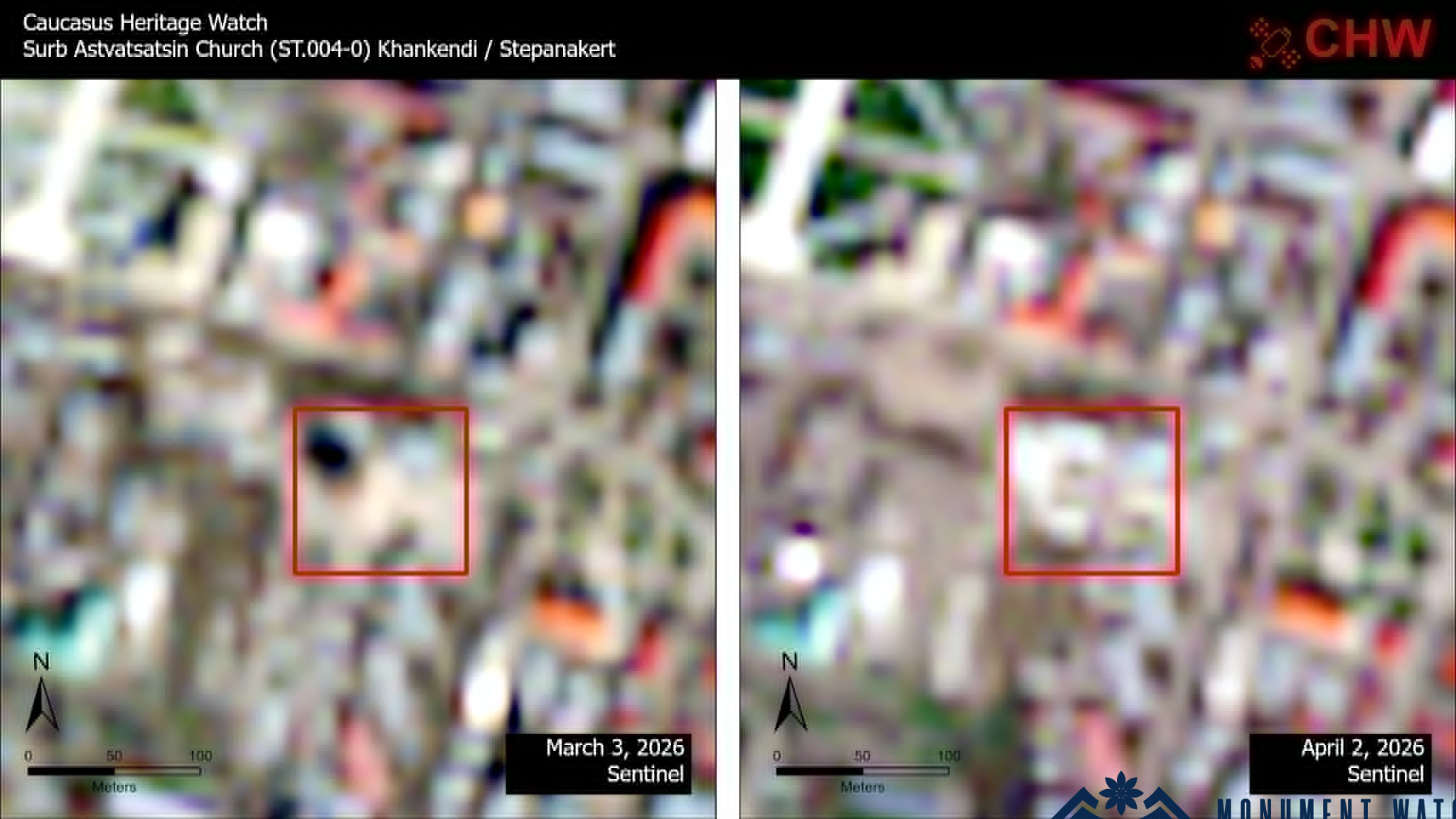
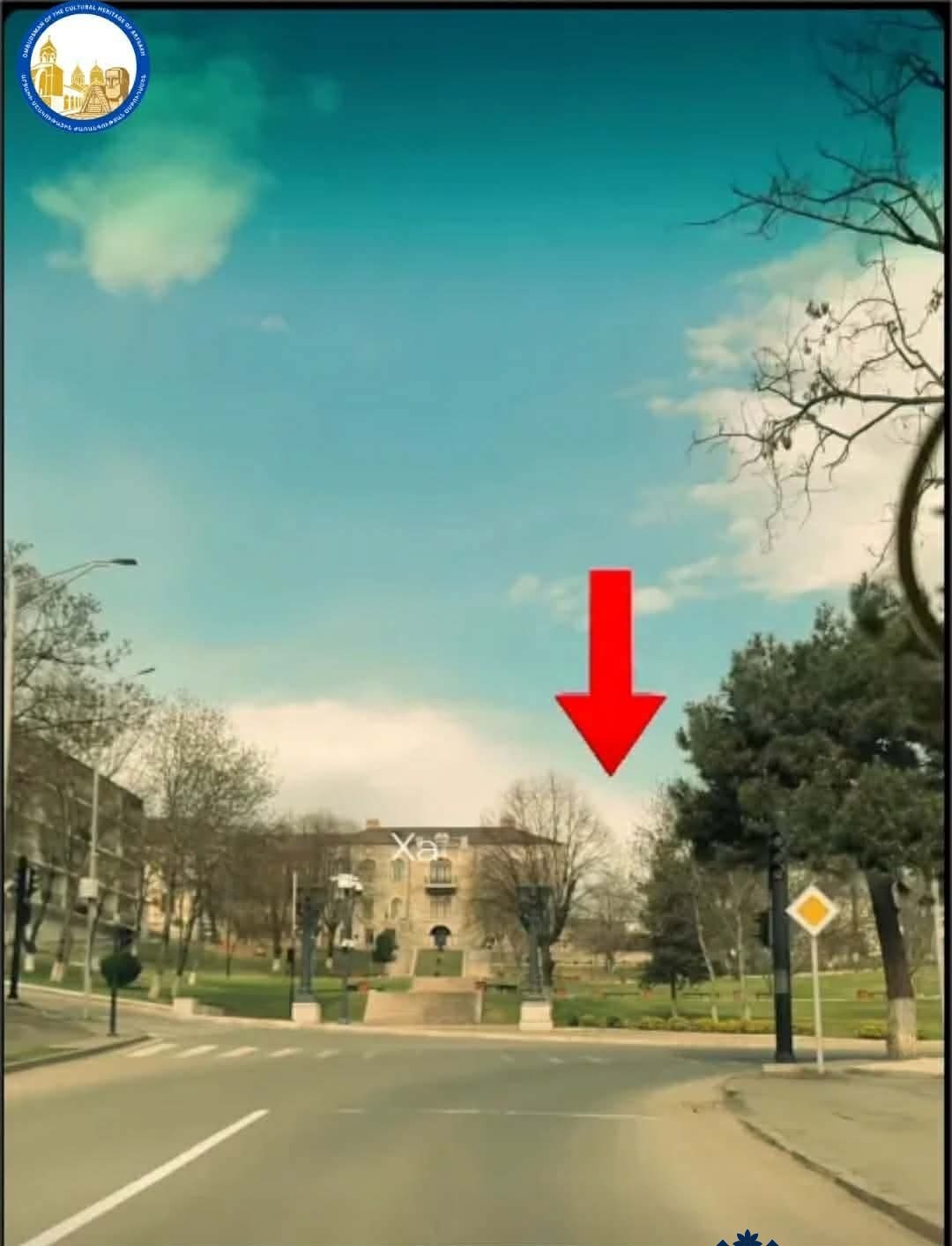
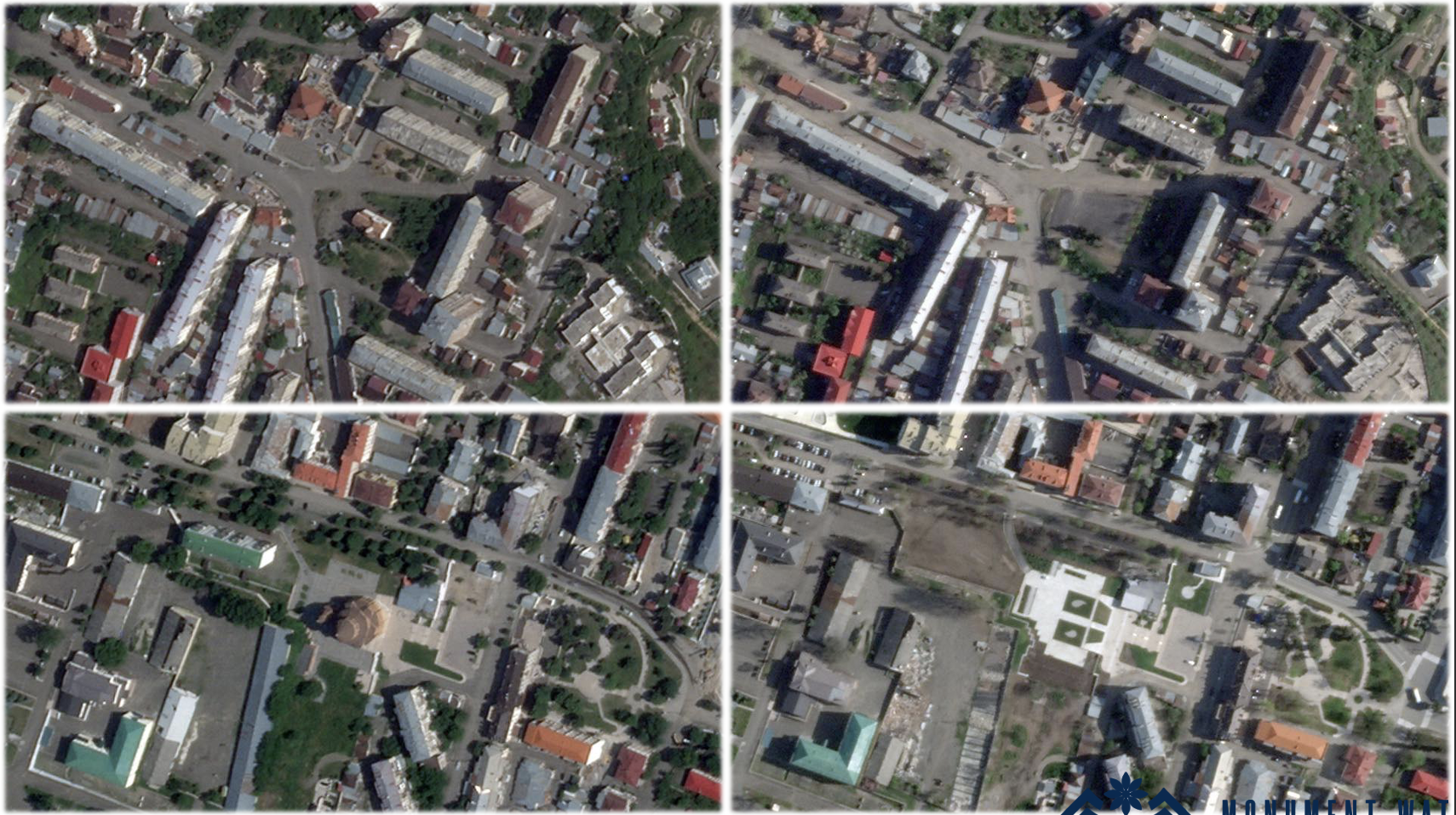
The complete destruction of the cathedral was also confirmed through satellite imagery provided by our partner, the Caucasus Heritage Watch programme (Figs. 3, 4).
Later, satellite images provided by Planet Labs and published on Simon Maghakyan’s Facebook page once again confirmed the complete destruction of both the Cathedral of the Protection of the Holy Mother of God and Surb Hakob Church in Stepanakert (https://www.facebook.com/share/p/18NHC2Uzzp/; Fig. 5).
The architect of the cathedral was Gagik Yeranosyan, who succeeded, through the cathedral’s ground-plan and volumetric-spatial composition, in combining classical Armenian building traditions with modern construction technologies. For more details, see: The Cathedral of the Protection of the Holy Mother of God in Stepanakert.
It should be noted that the foundation-laying ceremony of Stepanakert’s main cathedral took place in 2006, performed by Catholicos of All Armenians Garegin II. The cathedral was officially consecrated on 7 April 2019 (https://www.youtube.com/watch?v=_AK9_2NVbmM).
The destruction of the Cathedral of the Protection of the Holy Mother of God in Stepanakert is yet another manifestation of the consistent anti-Armenian policy pursued by Azerbaijan toward the elimination of Armenian cultural heritage and, more broadly, the Armenian presence in the region.
Our response
The deliberate destruction of Surb Astvatsatsin Church in Stepanakert qualifies as a war crime under Article 8, paragraph 2(b)(ix) or Article 8, paragraph 2(e)(iv) of the Rome Statute, and may also amount to a grave crime against humanity under Article 7, paragraph 1(h): https://www.icc-cpi.int/sites/default/files/2024-05/Rome-Statute-eng.pdf.
The destruction of the church constitutes a gross violation of Article 4 of the 1954 Hague Convention for the Protection of Cultural Property in the Event of Armed Conflict, as well as Article 9 of the 1999 Second Protocol to the 1954 Hague Convention: https://www.unesco.org/en/heritage-armed-conflicts/1954-convention.
The destruction of the church is also a gross violation of the 7 December 2021 Order of the International Court of Justice of the United Nations (Order on Provisional Measures, Armenia v. Azerbaijan, https://www.icj-cij.org/node/106095). The Court obliged Azerbaijan to take all necessary measures to prevent and punish acts of vandalism and desecration directed against Armenian cultural heritage, including churches. The Court linked these acts to the 1965 International Convention on the Elimination of All Forms of Racial Discrimination, treating them as part of a state-level policy of encouraging anti-Armenian sentiment.
The deliberate destruction of the church in Stepanakert also violates the European Parliament Resolution of 10 March 2022 on the destruction of cultural heritage in Nagorno-Karabakh (No. 2582; European Parliament Resolution on the destruction of cultural heritage in Nagorno-Karabakh, 2022/2582(RSP), 2022). The resolution calls on Azerbaijan to refrain from any intervention and to preserve the principle of authenticity of heritage.
The demolition of the church also contradicts the European Parliament’s strategy on global cultural policy (European Parliament, Implementation of the European agenda for culture and of the EU strategy for international cultural relations, European Implementation Assessment, https://www.europarl.europa.eu/RegData/etudes/STUD/2022/734663/EPRS_STU(2022)734663_EN.pdf). This report highlights the protection of the cultural heritage of Nagorno-Karabakh as an urgent issue within the European cultural agenda.
This list could be extended further.
Customary international law—grounded also in the principal instruments of the field, namely the 1954 Hague Convention and the 1949 Geneva Conventions and their protocols—separates the right to respect for heritage from questions of territorial affiliation and the proclamation of national statehood, establishing the inviolability of heritage as a fundamental right deriving from the right of peoples to self-determination. In other words, customary international law makes the rule of the inviolability of cultural heritage during war binding even on states that are not parties to the relevant conventions. The tangible and intangible cultural heritage of the Republic of Artsakh is fully entitled to protection under international regulations and enjoys all guarantees that are binding on all states, including Azerbaijan.
The fact that the Republic of Artsakh has not been recognized by the United Nations as an independent state, and therefore is not a party to UNESCO and other relevant conventions, does not constitute an obstacle to the protection of its heritage. First, during the conflict and as a result of the occupation of territories, Azerbaijan—as a party to the Hague and Geneva Conventions and their additional protocols—is obliged not to damage, target, or subject to reprisals cultural heritage located either on its own territory, on the territory of another state, or belonging to another group. Second, in comparable situations, including the case of Artsakh, customary international norms and international humanitarian law apply and are capable of protecting heritage without preconditions.