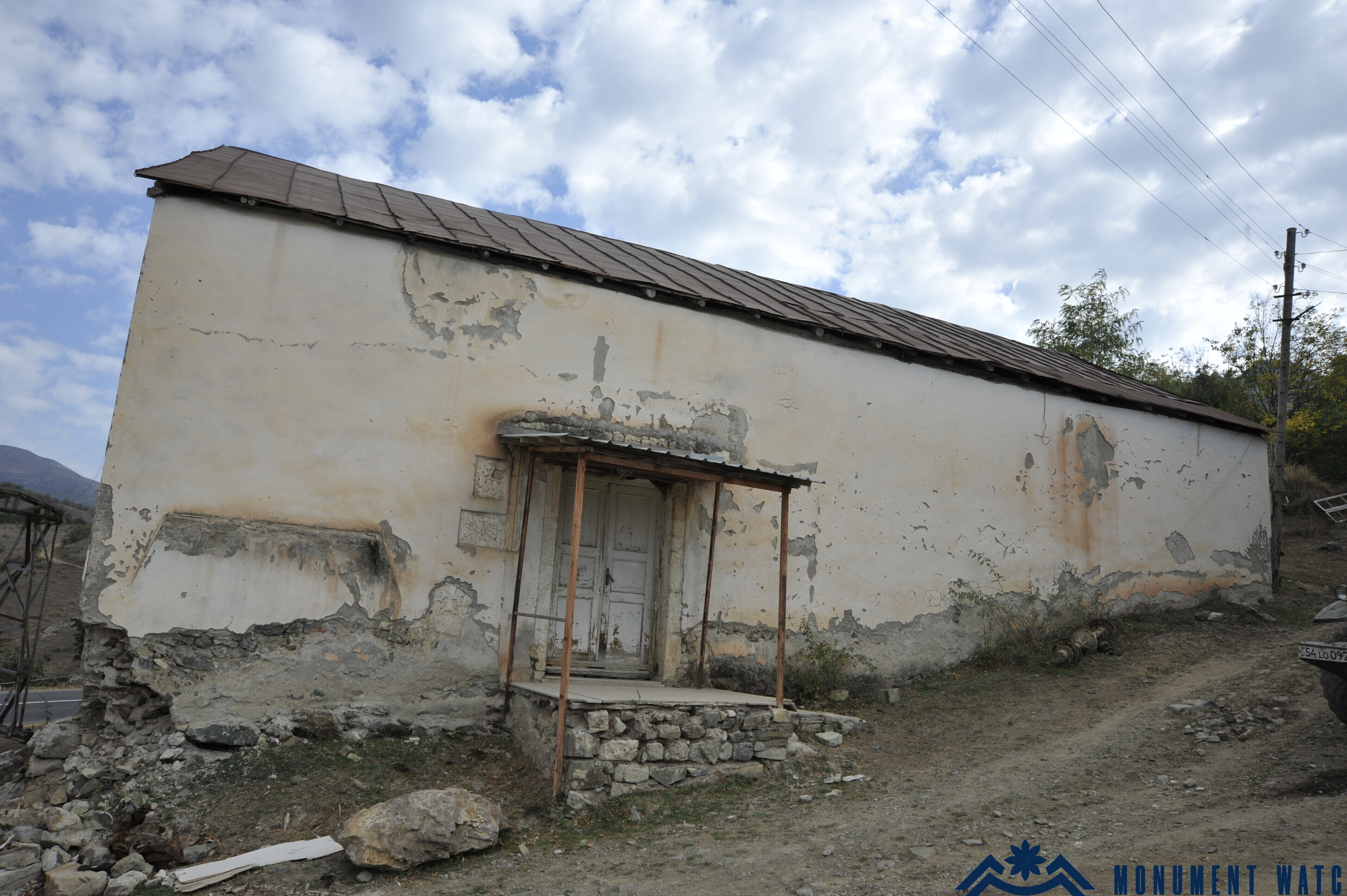
The Surb Astvatsatsin Church of Mets Shen Is Under Threat of Destruction
Caucasus Heritage Watch reports that Surb Astvatsatsin Church in the village of Mets Shen, Shushi District, is under threat, as earthworks were carried out to the east and north of the historic church between 31 October 2025 and 14 May 2026 (https://www.facebook.com/share/p/19GxqQti83).
According to the organization’s statement, these works are most likely connected with preparations for the construction of a new settlement, a process that has already begun. Fourteen Azerbaijani families, comprising 64 people, have already been resettled there.
Based on its architectural characteristics, the church is dated to the 17th century, although today it is in a dilapidated condition. During the Soviet period, the building was altered and used as a club. Although the walls are plastered, numerous elements from earlier periods remain visible within the masonry, including fragments of 12th–13th-century khachkars, tombstones, and other architectural and monumental elements. For more details on the church, see: https://monumentwatch.org/hy/monument/%d5%b7%d5%b8%d6%82%d5%b7%d5%ab%d5%ab-%d5%b7%d6%80%d5%bb%d5%a1%d5%b6%d5%ab-%d5%b4%d5%a5%d5%ae-%d5%b7%d5%a5%d5%b6%d5%ab-%d5%a3%d5%b5%d5%b8%d6%82%d5%b2%d5%a1%d5%b4%d5%ab%d5%bb%d5%b5%d5%a1%d5%b6-%d5%a5/
Our response
In this context, it is important to emphasize the European Parliament’s Resolution No. 2582, adopted in 2022, on the destruction of cultural heritage in Nagorno-Karabakh. In that resolution, the European Parliament called on Azerbaijan to ensure that any intervention at sites of Armenian heritage is excluded unless it complies with the principles of authenticity, and that any restoration work be carried out strictly in accordance with those principles.
Resolution No. 2057, adopted on 22 May 2015 by the Standing Committee of the Parliamentary Assembly of the Council of Europe, also addresses the restoration and reconstruction of tangible cultural heritage in occupied territories. It emphasizes the importance, in such cases, of preserving the intrinsic value of heritage and all of its constituent details, which also entails safeguarding the identity of the sites concerned. The document stresses the need to avoid reconstruction or renovation policies based on the ethnic or religious affiliation of heritage (para. 4.2). It also calls on states to preserve the authenticity of heritage in construction works and, in processes of restoration and reconstruction, to respect all historical layers while safeguarding the heritage’s original and genuine character (para. 4.4.6).
Through unlawful restoration interventions at the church, Azerbaijan violates the principle of authenticity set out in the Nara Document on Authenticity, adopted by UNESCO in 1994. According to the document:
“Conservation” comprises all efforts designed to understand cultural heritage, know its history and meaning, ensure its material safeguard and, as required, its presentation, restoration and enhancement. In this context, the ability to understand heritage depends, among other factors, on credible, truthful knowledge of it; knowledge and a proper understanding of the sources of such information are necessary prerequisites for assessing all aspects of authenticity and credibility.
(UNESCO, Nara Document on Authenticity, Art. 9, Values and Authenticity)
About the destruction of historical evidence, it should also be noted that, under the criterion of cultural significance, preserving the historical value of heritage entails safeguarding the historical evidence embodied in the place (Burra Charter, Article 2.3). Moreover, “any intervention in heritage that results in the loss of any aspect of its cultural significance — historical, aesthetic, spiritual, or social — deprives the heritage of its fundamental meaning and thereby destroys it” (Burra Charter, 2013, p. 14).